Showing posts with label Palestine. Show all posts

May 6, 2014

Explaining Max Fisher's Missing Maps

Over at Vox, blogger Max Fisher has a post up entitled "40 Maps That Explain the Middle East." If such a title makes you cringe, you are not alone. Often these types of posts which attempt to provide context do more to obscure reality and explain the creator's biases more than anything else. I am not going to dwell on each map. I won't claim to know enough about the nuanced political and historical geography in every one of these maps to offer a detailed critique here. However, one thing I do know very well is the nuanced political and historical geography of Palestine and particularly the events around the Nakba. These events are supposedly represented by map number 16 on Max's "explanatory" list entitled "Israel's 1947 founding and the 1948 Israeli-Arab War." Here is the narrative and graphic Fisher provides:


The first thing worth pointing out, and it may not be clear at the initial glance, is that the three panel image is not an original image from a singular source. Rather it is a combination of two sources. The map on the left is from PASSIA and it is a fairly standard representation of the 1947 partition plan. The two panels to the right of that come from Le Monde Diplomatique by Philippe Rekacewicz. These are the original maps which Fisher seems to have borrowed from. How he uses them and what he changes are enlightening. The original maps have a legend in French which Fisher omits and replaces with a heading he created. The first of the two Le Monde maps have the caption "Territory still held by the Israelis after the Arab attack in June 1948." Fisher changes this to simply "June 1948: Arab armies invade."

There is so much wrong here in Fisher's presentation that it is hard to know where to start. Let's try chronologically. First, we are presented with three maps, one from November 1947 and then we jump to June 1948. What happened in the months in between? What were the positions of the sides during that time and why is Fisher not explaining that? Second, in his attempt to simplify (or obfuscate depending on how much credit you want to give him) by jettisoning the French legend and providing his own heading, Fisher gets a very basic historical fact wrong. Arab army movement into Palestine did not happen in June of 1948, it happened in May.

You may be wondering why the French legend refers to "territory still held" by the Israelis. That is because Israeli conquest operations to extend their positions and grab as much land as possible began well before the Arab armies invaded. But it seems Max doesn't want you to know that or failed remarkably to explain it.

The narrative the Max adds to the spliced map is also misleading and reveals his biases. He writes:

...these are the borders that the United Nations demarcated in 1947 for a Jewish state and an Arab state, in what had been British-controlled territory. The Palestinians fought the deal, and in 1948 the Arab states of Egypt, Jordan, Iraq, and Syria invaded. The middle map shows, in green, how far they pushed back the Jewish armies. The right-hand map shows how the war ended: with an Israeli counterattack that pushed into the orange territory, and with Israel claiming that as its new national borders. The green is what was left for Palestinians.

We've shown before how this common Nakba narrative simply doesn't jive with history. The same thing is going on here. Max has boiled down the events of this period to a few sentences & key facts he thinks the reader really needs to know. He tells you the Palestinians "fought" the partition plan but doesn't tell you why. Apparently, all you need to know about this is that the Palestinians are rejectionists. Then he tells you the Arab states invaded (which happened in May 1948 though he gets it wrong and says June) but doesn't tell you anything about what happened between the partition plan and the Arab armies entering Palestine. Apparently, all you need to know about this is that the Arabs are a war-like people. Then he tells you the Arabs "pushed back" the Jewish armies, after which Israel launched a "counterattack." Apparently, all you need to know about this is that the Zionists were on the defensive here. To "push back" the Jewish armies, as Max claims, would require the Arab regular forces to actually take back from the Jewish armies land that they had come to hold. But what Max doesn't tell you is that in the vast majority of the land, the Arab armies entered parts of Palestine that had yet to be conquered by the Zionist forces. They overwhelmingly filled vacuums. Most interaction was at the margins. The notion that they "pushed back" the Jewish armies just isn't true. In fact, in many areas, the Zionist forces continued conquest operations into areas the Arab armies had filled. The overall trajectory of this war from the beginning, was a largely uninterrupted Zionist pushing of Arabs out of Palestine, not the other way around.

Perhaps the most important point here is what happened between the partition plan and the Arab invasion. This is what Fisher doesn't tell the reader at all. What happened during this period is the creation of a massive number of Palestinian refugees. All the major cities of Palestine including Yaffa and Haifa were depopulated of their Palestinian Arab inhabitants PRIOR to May 15th, 1948. By excluding this information, misrepresenting other information, and just getting basic facts wrong Fisher provides more propaganda than actual context.

The best maps that I have come across of these events are presented below (click to enlarge and zoom in, there is lots of detail). This eight-panel map set by Salman Abu Sitta details the stage-by-stage progression of Israeli military operations from November 1947 through April 1949. It also helpfully lists the total number of refugees created, the number of depopulated villages and the number of dunams occupied at each stage of the war.


Needless to say, it shows us something Fisher either can't or doesn't want to. Perhaps many of the other maps in his list are accurate and helpful but if he approached those representations with the same sloppiness or outright bias involved with map number 16, then they are probably equally worthless.

Seriously Max, you've got some explaining to do. Actually, never mind, you've explained enough.

read more...

Dec 13, 2013

PHOTOS: Palestine in the Snow


It is not very often that Palestine gets snow and rarely does it see this much accumulation. Palestine and much of the region is experiencing a powerful storm system that has resulted in snow, ice and rain from Cairo to Syria. Below are a few images of Palestine in the snow.


Tree tops in Yazid village near Nablus dusted with white snow...


A street scene in Moscow   Calgary  Oslo  ....Ramallah!


Snow falls on the Palestinian village of Qatanna near Jerusalem


Children play in the snow, a rare treat


A Caterpillar bulldozer takes a break from demolishing Palestinian homes to clear streets of Snow in Jerusalem


Will it be a white Christmas? Snow is falling here in Bethlehem's Manger Square


An image of a Nablus mountainside as snow blankets the city


An-Najah University in the Snow


A snowman made of hail in Gaza. Life in Gaza, made difficult by an Israeli siege, has just gotten much worse because of this storm. We love Gaza too!


Here the city of Rafah in Gaza is partially underwater...


Palestinians in Gaza being rescued from their homes by boat. Lack of electricity, running water and fuel for heat has made a bad situation worse.


A Palestinian child in Gaza tries to stay warm...


This man in Hebron maybe the first Palestinian member of the polar bear club.


A Christmas tree in Ramallah is covered in snow...


As is this Christmas tree at Manger Square in Bethlehem


Bab al-Amood, or Damascus Gate, an entrance to the old City of Jerusalem as snow falls


Farewell from a snow covered Palestine, see you next storm.

read more...

Nov 13, 2013

Relative failures at the NY Times

Readers of this blog know we look carefully at the New York Times and its reporting of issues in Israel and Palestine. Its been a while since I've done one of these posts, largely because of other commitments, but stories in the last two days have been impossible to ignore.

Yesterday, the Israeli government announced massive settlement expansion plans before apparently putting them on hold due to uproar. When the news first broke, every major Israeli paper reported on the massive number of housing units involved 20-24 thousand. This would make it the largest single announcement in recent memory. Along with the plans for the housing units that would move forward, Netanyahu apparently put a stop to plans for 1,200 or so units in the E-1 area which would connect the Israeli settlement of Maale Addumim with Occupied Jerusalem.

Here is how different Israeli papers chose to lead their stories on this news:

Haaretz: "The Housing Ministry has issued a tender to hire an architect to plan the construction of 1,200 housing units in the E1 area, which links Jerusalem and Ma'aleh Adumim in the West Bank, as part of a larger wave of tenders to construct some 20,000 housing units in the West Bank at a cost of nearly $13 million ([NIS 45 million)."

Yideot Ahranot: "The State of Israel has issued a tender for 20,000 new housing units in the territories, including in the disputed E1 area near Ma'aleh Adumim, but the Prime Minister's Office canceled the tender pertaining to E1, stating on Tuesday that "there is no need to pay international prices for a process that does not have great significance."

Jerusalem Post:"The Housing Ministry last week made plans to build nearly 24,000 new homes in settlements in the West Bank and east Jerusalem, Israeli media reported Tuesday."

Now, here is how the New York Times (which is an American newspaper by the way) decided to lead their story on this yesterday:

"With relations between Israel and the United States in distress over deep disagreements on Iranian nuclear negotiations and construction in West Bank settlements, Prime Minister Benjamin Netanyahu on Tuesday froze plans for building in a particularly contentious area outside Jerusalem known as E1."

The story here was the massive number of units (20,000!) slated for development. Every Israeli newspaper managed to prioritize that part of the story correctly. Yet for the New York Times the story, written by Jodi Rudoren, was not that 20,000 new settlements units were closer to being built but rather that Netanyahu put a stop to some settlements.

It is absolutely dumbfounding that Israeli papers continue to report more critically of their government than papers in the United States. In fact, the headline of the NYT story yesterday was "Netanyahu halts some settlement plants, but others to proceed." It would make you think that the majority were initially halted and the minority were to proceed but in fact it was the other way around, twenty-fold!

To their credit, the NYT has since changed the headline and the first paragraph in the online version of the story. It is unclear what version appeared in print. You can see the old headline in the URL. But how on earth any responsible journalist or editor could pen or approve the first version at all is beyond me.

That brings us to today's story, this one is by Isabel Kershner. Questions have been raised in the past about Kershner's ability to report accurately given the apparent conflict of interest she has due to the work her husband does. Her story is about the stabbing death of an Israeli soldier.

It opens:

"A Palestinian teenager fatally stabbed a 19-year-old Israeli soldier on a bus in northern Israel on Wednesday, according to the police, stirring outrage in Israel and injecting another element of uncertainty into a peace process already in deep crisis over Israeli settlement plans in the West Bank."

So a Palestinian kills and Israeli soldier and we are told about how that might impact the peace process. OK, go on. Here is the meat of the story (emphasis mine):

The stabbing Wednesday, the first such deadly attack inside Israel recently, took place when the bus, traveling from Nazareth to Tel Aviv, pulled into the station in the northern town of Afula. 
 The Israeli military said that the soldier, Eden Atias, 19. was in uniform at the time of the attack and had been on his way to an army base. He was stabbed several times in the upper body, according to Micky Rosenfeld, spokesman for the police. Mr. Rosenfeld said a 16-year-old Palestinian from Jenin, West Bank, was apprehended at the scene and had told security personnel under questioning that he had acted to avenge one or more relatives serving time in Israeli prison. Israeli news media identified the suspect as Hussein Jawadra. 
The attack came after a string of violent incidents in the West Bank in recent months that ended a period of relative calm, leading to calls from rightist Israeli politicians to re-examine Israel’s agreement to release 104 long-serving Palestinian prisoners from Israeli prisons in four batches as part of an American-brokered deal to resume peace negotiations. Two of the four groups have already been released. 
Since September, an Israeli soldier was killed in Hebron, apparently by a Palestinian sniper, an off-duty soldier was killed by a Palestinian acquaintance who had lured him to the West Bank, and a retired colonel was bludgeoned to death outside his home in the Jordan Valley. Israeli security officials have attributed the rise in attacks to unrelated individuals rather than an orchestrated campaign backed by militant groups.

So after we are told about the details of this incident from an Israeli military source, we are provided a particular context of violence in which this incident occurred. The notorious "period of relative calm" rears its ugly head again. We've explained how misleading this term is in the past here and here. Then the author enumerates every Israeli death since September. But what about violence against Palestinians?

Way down in the penultimate paragraph, number 11 of 12 to be precise, Palestinian casualties get a mention; a whole fraction of a sentence, just before we are reminded of the Israeli casualty again:
A number of Palestinians have also been killed in clashes with Israeli soldiers in recent months, and the stabbing on Wednesday is likely only to widen the gulf between the two sides.

A number? What number? What circumstances? When? What are their names? What are their stories?

For some actual context that more closely mirrors reality, here are some numbers:

5 - The number of Palestinians killed by Israeli forces since September

516 - The number of Palestinians injured by Israeli forces since September

736 - The number of arrest operations carried out by Israeli forces against Palestinians

2,368 - The number of fruit trees (olive or otherwise) destroyed by Israeli forces or Israeli settlers since September

123- The number of structures demolished by Israeli forces since September

176- The number of Palestinians displaced or made homeless as a result of demolitions since September

16,962 - The number of days the Israeli occupation of the West Bank and Gaza has persisted for


These numbers, compiled from weekly UN OCHA reports during this period, do not even include much of the routine Israeli settler violence that has spiked during this season. Yesterday, for example, Israeli settlers dropped a large stone from a high point above a Palestinian walking in an alleyway below them, cracking his ribs, vertebrae and rupturing an artery leaving him in a coma.

For Kershner and the NYT, this entire system of violence, from the killings to the injuries to the systematic destruction of property, is summed up as an unidentified number, in half a sentence, in the second to last paragraph, in a story mostly dedicated to Israeli victims.

Readers deserve a better contextualization of the violence occurring in Israel/Palestine than what the NYT has been offering.


read more...

May 25, 2012

Settler Violence Happens, On Camera and Off


Earlier this week, an unarmed Palestinian was shot in the head by an Israeli from the settlement of Yitzhar in Nablus when a group of settlers, accompanied by soldiers from the Israeli Defense Forces (IDF), attacked the village of Asira al-Qibliya. Though horrific, it’s actually nothing new. B’Tselem, the Israeli human rights group who released the video and who regularly records incidents of violence in the Palestinian territories, said the occurrence itself was not unusual; what was unusual was actually having cameras there this time to record it.

The news story spread like wildfire. Although settler attacks on Palestinians occur nearly every day (and many accompanied by the IDF), they rarely make it to international headlines, let alone with this ferocity.  Why the difference with this story? News sites state it’s because of the direct video evidence of the attack and the apparent audacity “that the soldiers present did not act to prevent the settlers from throwing stones and firing live ammunition at the Palestinians.”

This explanation holds no ground. Just three days later, another video was released showing a settler, with IDF soldiers standing by idly, violently confronting Palestinians in the South Hebron Hills. Unsurprisingly, this story was not caught on by high-profile international media, despite its similarities to the video released Saturday.

REPORT: When Settlers AttackThe Palestine Center released a report on settler violence in February with data from 2004 – 2011 which makes Saturday’s incident that much easier to understand in the perspective of years of perpetual attacks by aggressive Israeli settlers.


In the report, we see that the extent and frequency with which settler violence is perpetrated intensifies with every passing year. Not only has the total amount of incidents per year increased, but settler violence particularly in Nablus (home to the shooter in this week’s incident) has escalated in the past two years to such a degree that now the most attacks per year occur in Nablus, two or three times that of any other governorate.* Indeed, Yitzhar perpetrated more attacks against Palestinian villagers than any other Israeli settlement in our data, making it the most violent settlement in the occupied territories.

According to B’Tselem, the attack on Asira al-Qibliya on Saturday began with settlers from Yitzhar lighting fields on fire and throwing stones at houses and residents. Stone throwing and arson are two of the top tactics chosen by violent settlers, as shown in our report. Even when this particular event escalated to live fire, the settlers were using a tactic employed by five percent of other attackers in 2011.

As for the rationalization behind this particular incident, the spokesperson for the Yitzhar settlement said that the settlers had traveled to Asira al-Qibliya to put out fires he said were started by Palestinians, and then had only fired shots from their M-16s when their lives and those of the soldiers ‘guarding’ them were threatened by young Palestinian stone-throwers. Though the videos of the incident from two different angles reveal a different narrative, our report also indicates that most incidents of settler violence are NOT positively tied to incidents of Palestinian violence.

And with the international community up in arms over the recorded passivity and complied consent of the IDF in this one incident of settler violence against Palestinians, we remind the world that over 90 percent of all villages facing multiple instances of settler violence are located in areas under Israeli security jurisdiction. Settlers perpetrating violence against Palestinians and their property know they are not likely to face any punitive action from the Israeli authorities for their crimes, so they choose to attack villages under Israeli authority. In this case, the settlers chose to fire at unarmed Palestinians in full view of soldiers from the IDF with complete faith that there would be no interventions or repercussions for their actions. Not only does the IDF fail to protect Palestinians from violent settlers, but it also offers complicity by accompanying settlers on their violent hateful tirades. It is Israeli government inaction and not actions that allowed this and other acts of settler violence to occur.

The IDF and the Israeli government must protect Palestinian civilians in the territories it occupies, must act to prevent settler violence as it occurs, and must immediately, thoroughly and credibly investigate this and other instances of Israeli settler violence with appropriate sentences adjudicated. If not, the news media will only see more and more cases of extreme settler violence against unarmed Palestinians.

Let’s see if the next time a Palestinian is shot on camera if it will even make the news ticker, let alone headlines.


*except for Hebron, which it surpasses by 25 percent
read more...

Feb 16, 2012

The Jab'a Accident and the Infrastructure of Occupation

When I heard the tragic news this morning about an accident involving a school bus near Jab’a that left several young Palestinian school children dead I was devastated by the details and began to think about how scared those children must have been and how difficult life will be for the families of those involved going forward. It is sad and horrifying any time innocent people, especially children, die or get injured.

I remembered taking the school bus on a daily basis here in the States from elementary school all the way through high school. Our buses always stopped at railroad tracks, even when there was no trains in sight or approaching. It was a policy to stop and have the bus driver open the door and look both ways. At the time, it seemed like an over-cautious waste of time to me but I know it reflects the utmost need to protect society's most valuable assets; it's children.

So as I continued to listen to the details I went from being sad, to confused and finally, to angry. Something didn’t make much sense to me. Here are some of the details reported from Haaretz:

The bus was carrying children from a kindergarten in the Shuafat refugee camp on their way to a field trip to a park near Ramallah.

According Shuafat residents, the kindergarten children travelled in two buses, each holding about 80 passengers, including teaching staff and crew.
Here is more from the Jerusalem Post:

The bus had set out from a Palestinian school in Shuafat in east Jerusalem to the Ramallah area for a day trip, carrying some 60 children. It turned around and headed back because of treacherous weather conditions. It was struck by the truck en route to east Jerusalem....
The accident occurred just after 9 a.m. at Kikar Adam, a major intersection north of Jerusalem between highway 60 and highway 437.
The children on the school buses were from the Shufaat refugee camp. Shufaat is inside the municipality of Jerusalem. Their destination was toward Ramallah which would mean they’d have to pass through Kufr Aqab, another Palestinian locality inside the Israeli municipality of Jerusalem.


I know this gets complicated, so maps help to simplify things. In the map on the right, you can see where Shufaat is and where Kfur Aqab is. Kufr Aqab is essentially the gateway to Ramallah from the Jerusalem municipality. The green route, in my estimation, signifies the most logical, shortest, straightforward and safest route to get from Shufaat to Kufr Aqab. However, the bus didn't go that way.

The buses filled with Palestinian school children instead followed, again in my estimation, the red route, which is longer, far more rural, more dangerous, out of the way, narrower, more curvy and hillier than the green route. The yellow circle is an estimation of where, based on the Jerusalem Post's account, the accident happened. So why on earth would a bus filled with Palestinian children take the red route instead of the green route?

Because even though both Shufaat and Kufr Aqab are part of the Israeli municipality of Jerusalem, the infrastructure of apartheid, in this case the wall, makes the safest and most convenient route unavailable to these residents of Jerusalem because they were born in the wrong neighborhood- a Palestinian one - on the other side of the wall.

Have a look at this next map to the right where the green and red lines are my estimations of the different routes as in the map above, but this version includes a thick black line indicating where the wall exists preventing Palestinians from taking the safer, more direct route in green.

I want to be clear, the children that died today died in an accident. This accident was most likely a direct cause of poor weather conditions and I'm not placing blame on Israel or Israelis as the direct cause of this accident. Rather, what is important to note here is that the infrastructure of occupation regularly forces Palestinians into inconvenient and, in many cases, unsafe conditions where the likelihood of dangerous events increases. Accidents can happen anywhere, especially when weather conditions are bad, but there is little doubt in my mind that the chances of such a thing happening decrease when you are spending less time on the road in a safer more direct route.

As a Palestinian, you can not travel from Ramallah to Bethlehem, for example, without taking a long and often dangerous drive circumventing Jerusalem and going nearly as far as Jericho to do it. For many locals, this is just something they have gotten used to. Sure the road is more dangerous, but it is something they do regularly so they may forget how much safer one can be taking other routes if they were available.

As someone who spends most of my time in the United States but visits the region often I have taken both the red and green routes on different occasions and it is easy to notice that the green route is much, much safer.

This is life in Palestine. This is occupation. No one should have to get used to it. If we can learn anything from this tragedy today it is that even when there are no soldiers, incursions, weapons or settlers involved, the very infrastructure of occupation increases the risks and challenges facing Palestinians on a daily basis.


read more...

Aug 3, 2011

Palestinian Gandhis Part VII: Young Filmmakers


In the final post of our "Palestinian Gandhis" series, we come across two young artists, "Arab" and "Tarzan," whose peaceful resistance mainly takes the form of film, though their voices are also heard throughout Gaza in murals and street art. In this installment, they discuss their influences, their intentions, and their work.

Filmmaker Pam Bailey had this to say about them:

The power of art as a tool of resistance, cutting right to the heart of oppression and betrayal, is unleashed in the work of Mohamed ("Arab") and Ahmed ("Tarzan") Abu Nasser. The identical twin brothers are true "renaissance men" – they play the guitar, paint, sketch, write screenplays, direct and act. However, filmmaking is their favorite form of expression, despite the fact that Gaza has no film school, and no cinemas.

The brothers are at once boys at heart – acting younger than their 20 years – and ancient in their lived experience. In the video you are about to watch, you will see at one point a close-up of an anguished woman, painted in muted swirls of greens, blues, orange and black. The girl was Tarzan’s love, killed in the Israeli onslaught of 2009. The sketched portraits of a woman you will see strung across their room are of their mother.

There are very few art competitions or exhibitions in Gaza, but Arab and Tarzan took top honors in one of the few, sponsored by the Al Qattan Foundation. In their winning entry, they created a series of mock promotional posters, each one advertising a movie named after an actual Israeli military operation. The obvious violence depicted on the posters (as entertainment) creates a jarring juxtaposition to the idyllic names Israel gives to its invasions: "Summer Rain," "Autumn Clouds," "Colorful Journey."

In the companion film, for which the brothers wrote the script and acted, Arab and Tarzan take on a much more controversial topic: intra-Palestinian (Hamas vs. Fatah) fighting. The film, called "Colorful Journey" after an Israeli attack on the West Bank, is shot in Hollywood style, showing two Palestinians stalking each other, preparing to pounce and kill. The fact that the two men (Arab and Tarzan) look exactly alike brings home the point that their feud pits Palestinians against themselves. Just as it appears the "moment of truth" is at hand, a helicopter appears above, and it is clear – without being explicit – that the two have been killed by this new intruder. The helicopter represents Israel, and the message is loud and clear: Why are Palestinians fighting each other, when they face a common threat that will destroy them both?

These are risky subjects for such young men to take on. But when you grow up in Gaza, this is the stuff of survival.


read more...

Jul 15, 2011

Dramatic Spike in Settler Violence Sadly Predictable

For the past 18 months we've been working at the Palestine Center to analyze Israeli settler violence against Palestinian civilians and their property. We've put together the most comprehensive database of Israeli settler violence available and continue to add data to our records. In April of this year we presented an analysis covering the period of September 2004-February 2011, and at the time I noted an dramatic trend:

The important news is this. A very strong, noticeable increase in Israeli settler violence over the past five years, and mind you 2011 is on pace to beat 2010. We started with an extremely violent two months of 2011 and it shows no indication of slowing down.

And it didn't slow down. Now, the UN Office for the Coordination of Humanitarian Affairs (UNOCHA) in the Occupied Territories is reporting a major increase in violence:

Settler-related incidents resulting in Palestinian injuries and damage to property are up by 57 percent this year, according to the U.N. Office for the Coordination of Humanitarian Affairs, which documents violence in the Palestinian territories...

Palestinians have been injured by settlers this year at double the rate of 2010... So far this year, 178 Palestinians have been stoned, run down or shot at by settlers, compared to a total of 176 for the whole of 2010. Three Palestinians have been killed by settlers this year.
It seems like we were right. The troubling part is that, when you study settler violence over time you realize that the most dramatic spike that comes on an annual basis is during the olive harvest season -- at the end of October. With a 57% increase in violence by July, the number of violent incidents against Palestinian civilians may well double last year's numbers.

The entire presentation is available here and you can also read through a number of posts we have authored on settler violence focusing on various aspects including, the Israeli state's failure to properly punish perpetrators of settler violence, how Palestinian livestock is threatened, how Hebron is ground zero for settler violence, how the media fails to cover settler violence and the use of different tactics by settlers like vehicular attacks and arson.

Interestingly, from 2006-2011 we have only seen increases in settler violence with each year topping the previous one. In fact, in the 5 years from 2006-2010 we have seen a 152% increase in settler violence incidents. During the same period of time, as reported recently by Obama administration officials to the Congress, "terrorist violence" from the West Bank is down 96%.

With such an inverse relationship between the numbers (and keep in mind settler violence doesn't include other methods of violence used against Palestinians by the occupation, mostly by the IDF) Palestinians have every reason to question who is really benefiting from PA-Israel security cooperation. The answer is simple and the numbers don't lie; it is definitely NOT the Palestinians.
read more...

Jul 6, 2011

Palestinian Gandhis Part VI: Breakdancing


Similar to the last segment in our profiles of "Palestinian Gandhis" which looked at "resistance Hip-hop" in the Arab World, the Camp Breakerz are using their love of breakdancing as their form of nonviolent protest. It's a way for them to take the negative energy stemming from the stresses of constant siege and turn it into an art form that they can show the world. They are putting their own spin on it, teaching it to the youth of Gaza, and starting a peaceful revolution of their own.

Here's what filmmaker Pam Bailey said about this excerpt:
Costanze once said, "dancing is like dreaming with your feet." And that’s what it is for the young men in the Camps Breakerz breakdancing crew. Ask one of the nine members, all from Gaza’s Nuseirat refugee camp, why they like breakdancing (a type of hip hop, along with rap), and they will invariably tell you they feel "free" when they "break."

Breakdancing is a style of street dance that was created and developed as part of hip-hop culture among African Americans and, later, among Latino youths in New York City. For that reason, like rap, breakdancing is often ostracized in Gaza as foreign to the Arab culture. However, the Camps Breakerz have made the art very uniquely their own, while also giving other young people a productive outlet for their energy and frustrations.

The crew chose the name Camp Breakerz in part to advertise their pride in their origins. "People think (refugee) camps are just for poor people with no culture," says Ahmed, who danced until an Egyptian soldier shot him in the knee, and now serves as manager. "But in fact, the camps have talent."

Breakdancers are called b-boys, or b-girls. Unfortunately, because of the conservative culture in Gaza, breakdancing is not yet considered acceptable for girls, and certainly not in mixed company. However, the crew is committed to helping interested girls "dream with their feet" as well, and are looking for suitable sponsors and opportunities.

Sponsorship in general, however, is one of the Camps Breakerz’ biggest challenges. Like any organization, they need money, facilities and equipment to survive and grow. As a result, most available funds go to formal, and bureaucratic, NGOs (non-governmental organizations). The Camps Breakerz are forced to practice in Ahmed’s cramped home (the sports club in which they used to practice was destroyed in the last Israeli war), and they don’t have the mattresses, etc. needed to train others elsewhere. But now there is good news! Until recently, they have been unable to leave Gaza to perform or compete with other b-boys. Now, an Italian businesswoman is working to bring them to Europe in the fall. Although Egypt now has eased the restrictions on its border with Gaza, allowing much greater freedom of movement, men between the ages of 18 and 40 still require a visa from Egypt or another country to leave – often very difficult to get. Wish them luck!


read more...

Jun 29, 2011

Palestinian Gandhis Part V: Lyrical Resistance

Resistance Hip-Hop in the Arab world has taken off in recent years. Pioneers in this area include Palestinian groups like DAM who have used English, Arabic and Hebrew lyrics to convey messages of resistance through hip-hop. In this installment of our "Palestinian Gandhis" series, we introduce you to the DARG team, a Palestinian hip-hop group from Gaza that raps about resistance. In this video interview with the group, they discuss what hip-hop means to them and the struggles of being hip-hop artists under occupation and in Palestinian society. Filmmaker Pam Bailey explains further:

Hip-hop – which includes both rap and breakdancing – first gained prominence in American ghettos among inner-city youth, who inventively made “something out of little or nothing” to express their gritty reality. Perhaps it’s no surprise, then, that hip-hop spread to other regions where youth struggle to define their identity in the face of adversity. Rap is like spoken-word poetry, a torrent of free-association – with no filters or concern for political correctness. It’s this raw, “uncut” characteristic, its fans say, which allows rap to speak directly to the soul.

For all of these reasons, rap has taken root in the Gaza Strip as well – but not without a fight. Because of its Western roots, rap is scorned – and even condemned -- by many in the conservative, traditional culture of the Strip. In 2009, the Hamas government even shut a show down. But despite – or perhaps because of – this “go against the grain” attitude, rap is coming into its own in Gaza. And the band featured in this video – the DARG (Da Arabian Revolutionary Guys) Team – is starting to get attention internationally as well. Even if you don’t like rap, and few outside the “X Generation” in America do, I encourage you to watch this video. The youth of Palestine will largely determine its future since in Gaza they account for more than half of its population, and rap puts their hopes, dreams and angst into sharp focus.

Unlike most of the unsung heroes featured in this series, the DARG Team recently managed to leave the Strip and tour Europe. When I first met the band in the Winter of 2010, they had been trying unsuccessfully for months to leave Gaza to tour. The band had been “adopted” by filmmakers Nicolas Wadimoff and Beatrice Guelpa of Switzerland, when they visited Gaza the previous year to shoot their documentary, “Aisheen” (Still Alive in Gaza). When the two journalists returned home, they linked the DARG Team with rappers there and a partnership was born. That’s why I work so hard to persuade artists, businesspeople, teachers, etc. to travel to Gaza and elsewhere in Palestine; once they are face to face with the people, and discover the talent and energy there, they become champions. Not to be defeated, the DARG Team and their Swiss counterparts staged a “virtual concert,” which I was fortunate enough to observe. The team performed in Gaza City, the Swiss performed in Geneva, and the two were hooked together via satellite. The connection was a bit choppy at times, but it was strong in many other ways.

A year later, their European partners were successful, and the DARG Team got the necessary visas to get them out of Gaza. If you need any other proof of the transformative power of freedom, this is it. Prior to their six-month tour, the team’s lyrics were dominated by death and destruction – particularly after the 2008/9 war. (The song “23 Days” is featured in the video as an example of the team’s pre-tour lyrics.) Following the tour, when they readily returned to Gaza, their songs were about pride and identity. (It is a myth that all Gazans want to permanently escape. If they were allowed to come and go like most of us can, the majority would ultimately return home.) They had witnessed the solidarity of many others in the global community, and tasted what the world had to offer. The post-tour lyrics of "Heads Up" reflect that new, optimistic outlook. Listen for yourself:


read more...

Jun 27, 2011

Palestinian Gandhis Part IV: The Cactus is Mightier than the Sword

Expressing resistance comes in many forms. For some Palestinians, art is the form of expression they are most interested in. In this next installment of the Palestinian Gandhi project you will meet a Palestinian artist in Gaza resisting Israeli oppression through his creativity. Pam describes the work of Mohammed Al-Hawajri in Gaza below:

When you can’t or refuse to fight back with guns or rockets, art is a powerful, universal form of expression that speaks directly to the heart – and without need for a shared language. That is true in Gaza as well, but artists there face unique challenges. With unemployment over 40% and poverty at an alarming 70%, few Palestinians living in Gaza have sufficient discretionary income to spend on art. The near impossibility of earning a living as an artist results in many parents practically ordering their children to abandon any thoughts of pursuing art as a serious endeavor. It doesn’t help that UN schools – which serve 70 percent of the population – no longer offer classes in art, due to the shortage of classroom space. (The UN Relief & Works Agency has been unable to import enough construction materials to rebuild war-damaged schools, or build new ones, due to the Israeli blockade. As a result, the schools are operating on double shifts, with many children sharing desks.)

At the university level, there is only one art department in all of the Gaza Strip, at Al-Azhar It is a testament to the human spirit that some Gazans persist in their ambitions nevertheless – and are quite resourceful in finding inspiration in the midst of destruction. In this video, Mohammed Al-Hawajri creates his works out of cacti – which he sees as a metaphor for Palestinians, who thrive despite the harsh environment.

Check out the video below interviewing Mohammed Al-Hawajri:


read more...

Jun 22, 2011

Palestinian Gandhis Part III: Activism Begins at Home

The third installment in our "Palestinian Gandhi" series highlights the work of longtime Palestinian activists Mona Al-Farra. Al-Farra, a life-long Gaza resident, is interviewed below. Pam Bailey provides this introduction:

Many of the “Gandhis” featured in this video series are relatively unknown, even within some areas of the Gaza Strip. As small as it is (about twice the size of Washington DC), southern Gaza is considered culturally different from northern Gaza, for example. And residents rarely travel between them or know the people outside of their “stomping grounds.” However, Mona El-Farra is well-known everywhere, and even to many activists outside Gaza.

A physician by training and a human and women’s rights activist by practice, she is a native Gazan, born in Khan Younis, in the southern stretch of the Strip. Mona was transformed into an activist at the young age of 13, during the 1967 (“Six Day”) war. She and her family hid in the basement of their home for about five days, then came face to face with Israelis for the first time – but as occupiers. From that day on, she joined the demonstrations protesting the occupation. The war had another effect – it decided her career. Mona decided to go to medical school because of what she saw during the war -- the wounded people overcrowding hospitals without adequate medical equipment. However, as you will learn from the video, she has since branched out into many other charitable endeavors.

Another distinguishing characteristic of Mona is the fact that although she is Muslim, she does not wear a hijab -- whereas most women in Gaza do. What many people do not realize is that in the 1980s, when Mona was growing up, most Palestinians in Gaza did not wear the hijab (or the accompanying long overcoat called a jilbab). The traditional Islamic dress did not come into “vogue” in Gaza until the outbreak of the first intifada, when – for many Palestinians -- it became an emblem of their identity and resistance to occupation. (Note – this was well before Hamas took over governance of Gaza in 2006. Although this form of dress has become more entrenched under Hamas, it did not begin with the party.) While Mona is a firm believer in the right of women to dress as they please, she also eloquently makes the point that women have long played strong roles in Palestinian society – no matter what they wear.
An Interview with Mona Al-Farra:


read more...

Jun 20, 2011

Palestinian Gandhis Part II: Blogging to Resist

The second installment of the Palestinian Gandhi project featured here focuses on two Palestinian bloggers in Gaza who are the subjects of the interviews below. Filmmaker Pam Bailey notes:

This first video profile features two of many bloggers who have begun writing about the reality of life in the Gaza Strip. Although Gaza-based blogs date back to 2004, there has been a virtual boom since Israel launched its massive attack on the densely populated Strip in the winter of 2008/9. In a classic example of “blowback” (unintended consequences), Israel’s aggression served as a motivator for many young Palestinians in Gaza to find new, creative ways of speaking out. The first young blogger featured, Sameeha Elwan, speaks eloquently of being “shocked” into activism. (Image Right: Gaza bloggers Jeehan AlFarra and Sameeha Elwan)

Another young blogger, Mohammed Suliman, writes: “Despite its many severely negative results, Israel’s siege of Gaza has offered Palestinian youth a service none had offered before. It offered new paths for us in our struggle for freedom, deepened our patriotic sentiment and finally created an environment that fosters a collective sense of selflessness and cooperation. It has created a young generation that truly cares.”

Most of the bloggers write in Arabic and address readers in Gaza, the West Bank and the Arab world at large, but a substantial number are writing in English to reach an international audience. And slowly, the number of their readers is growing, and foreign media (such as the popular American website Mondoweiss) are reprinting their entries. Listen for yourself, then check out their blogs, and see why.

The videos below introduce you to the 'Palestinian Gandhis' in this second installment, Sameeha Elwan and Jeehan AlFarra.


More on the project and the film maker is discussed in our introductory post. In the coming days, we will be posting several more interviews with "Palestinian Gandhis".
read more...

Introducing: The "Palestinian Gandhi Project"


There is a consistent effort to portray Palestinians as violent individuals, and this effort is tied directly to attempts to justify any Israeli action against Palestinians in the name of “security” or “defense.” In reality, Palestinian resistance to the Israeli occupation and colonization of their land is diverse and overwhelmingly non-violent. Just because Palestinian non-violence doesn’t get the media attention violent conflict does, doesn’t mean it isn’t there. But how would anyone outside of Palestine know? (Image right: A Palestinian woman defies Israeli declared "buffer zone" in Gaza to harvest wheat.)

Pam Bailey, an American “corporate refugee” as she calls herself, traveled to Gaza to see for herself what was happening in the region. The product of her trips became “The Palestinian Gandhi Project” which Permission to Narrate is proud to feature here. I asked Pam to explain a bit about this:

I first traveled to the Occupied Palestinian Territories in 2007 on an adventurous whim. It changed my life. Three more trips to the region later, I decided to live and volunteer in the Gaza Strip, because I realized that I would always be a bit of an ignorant do-gooder if I didn’t live in my chosen region of focus – Palestine – long enough for the people to begin to forget I’m a guest. Six months isn’t long compared to a lifetime, but I felt it was enough to put “my feet firmly on the ground,” as well to teach me a bit about the diversity and nuances within the overall culture.

When I returned to DC, I spent the next three weeks on a speaking tour from one coast to the other…One of the most common comments I heard is “What the Palestinians need is a Gandhi, or Martin Luther King Jr.” Yet, Palestinians have many “Gandhis” among them who are resisting occupation and corrupt government every day in very creative ways. So, I joined with a friend (Keren Batiyov) to document these stories and give them an audience. When I returned to Gaza this January, I kickstarted the project with some of the interviews we will be featuring here. They do not have the notoriety of Gandhi and MLK, but all they need is a platform. They also do not have a similar mass following — in many cases, because Israel has attempted to snuff out their budding fame by arresting and imprisoning them or their family members. Others are still young, only needing encouragement and recognition to become the leaders of the future. We hope to provide them a platform to amplify their voices. In the future, our plan is to augment this “oral library” with interviews from the refugee camps in Jordan and Lebanon (typically ignored completely by the media), as well as with Palestinians in the West Bank and Israel.

Check out this introductory video:


Over the next several days, we will be featuring videos from the project that allows Palestinians in Gaza who have chosen various methods of non-violent resistance to convey their stories, dreams and hopes to a global audience. The interviews are with activists, artists, bloggers, musicians, sculptors and performers who all understand their work as resistance to Israeli occupation and siege. Each video will be accompanied by a brief explanation of the setting and subject by Pam. Look for the next installment featuring Palestinian bloggers in Gaza later today!

It’s time to let Palestinians narrate their views on non-violent resistance.


You can support this project directly here.
read more...

May 31, 2011

What about "defensible borders" for Palestine?

When President Obama outlined his not so new vision for peace in the Middle East by saying the 1967 lines should be the baseline for territorial negotiations between Israel and the Palestinians, a rather ridiculous debate ensued with Israeli Prime Minister Benjamin Netanyahu maintaining that the 1967 lines were "indefensible."


The debate featured an overtly Zionist narrative with the more hawkish end of the spectrum arguing that the '67 lines were not defensible for a variety of reasons, while others argued otherwise. I don't intend to engage this debate, rather, this is a starting point to underscore just how absurd the mainstream debate about the larger issue really is.

Let's take a look at what President Obama said (emphasis mine):
So while the core issues of the conflict must be negotiated, the basis of those negotiations is clear: a viable Palestine, a secure Israel. The United States believes that negotiations should result in two states, with permanent Palestinian borders with Israel, Jordan, and Egypt, and permanent Israeli borders with Palestine. We believe the borders of Israel and Palestine should be based on the 1967 lines with mutually agreed swaps, so that secure and recognized borders are established for both states. The Palestinian people must have the right to govern themselves, and reach their full potential, in a sovereign and contiguous state.

As for security, every state has the right to self-defense, and Israel must be able to defend itself -– by itself -– against any threat. Provisions must also be robust enough to prevent a resurgence of terrorism, to stop the infiltration of weapons, and to provide effective border security. The full and phased withdrawal of Israeli military forces should be coordinated with the assumption of Palestinian security responsibility in a sovereign, non-militarized state. And the duration of this transition period must be agreed, and the effectiveness of security arrangements must be demonstrated.
There is plenty to discuss here but the fundamental problem lies in the contrast apparent in the first sentence of the quote: viable vs. secure.

The proposed outcome of American-led negotiations has always been a Palestinians state that is inferior - by design - to its Israeli neighbor. If the mediation was carried out in good faith, we'd be hearing about a secure Palestinian state living side-by-side with a secure Israeli state, but we are not. Instead, the American-led process is facilitating Israeli domination of Palestine either during occupation or after any potential "peace" agreement. If Washington believes Israelis are entitled to security more than Palestinians (as the policy suggests), attempts at American mediation will continue to fail.

That's why the fact that this defensible border debate was even taking place was so absurd. Did anyone even ask if that border would be defensible for Palestine? Was the question even raised by any mainstream American journalists? Of course not. Because the United States constantly views this conflict through the prism of Israeli security instead of mutual security or human rights.

Let's recap a few basic points:

1. Israel occupies Palestine and not the other way around.

2. Israel has peace treaties with Egypt and Jordan, the states on it's longest borders.

3. Israel has one of the most advanced armies in the world with a vast arsenal of offensive weapons.

4. Israel has hundreds of Nuclear Weapons.

5. Per U.S. and Israeli demands, the proposed Palestinian state would have no military.

6. Israel has actively and aggressively colonized Palestinian territory through the use of force, not the other way around.

7. Israeli settlers have a history of aggressive violence against Palestinians and zealously covet Palestinian territory.

And yet, despite all of this, the debate continues to be about whether the '67 lines are defensible for Israel? The logic, if it can be called that, behind the genesis of this debate is that Israelis have legitimate security concerns and the Palestinians do not, therefore, the Palestinians will have to trust the Israelis not to threaten their demilitarized state, but the Israelis can't be expected to trust the Palestinians. The Israelis, the logic assumes, always have good intentions while the Palestinians do not. And if the Israelis ever use force, it must be out of legitimate self-defense and is never put in the context of occupation.

That American policy toward Palestine continues to be based in these flawed and clearly biased assumptions is only further proof that American-led negotiations will not yield a just peace, and that Palestinians have every reason to circumvent them.


read more...

May 18, 2011

Understanding the 1947 UN Partition Plan

After many Palestinian refugees were killed or injured in the most recent Nakba Day protests, the events have forced a discussion of the period during which Palestine was depopulated of the majority of its native inhabitants. I recently wrote about how the mainstream media is doing a great disservice by distorting a historical narrative they had previously reported on. But despite this, in an era where the internet allows for rapid fact-checking and access to diverse information, the discussion about the Palestinian Nakba continues.

Yesterday, PLO Chairman Mahmoud Abbas published an Op-Ed in the New York Times where he discussed his personal experience as a refugee. The Israeli Prime Minister Benjamin Netanyahu responded to Abbas' piece with the token Zionist response to any Palestinian claims on the events of 1948. Netanyahu "emphasized the Palestinians' rejection of the UN's partition plan in 1947, while the Jews were willing to accept it."

"Don't you see," says the Zionist narrative, "they don't want a state. They want everything. We were ready to make a deal but they rejected it. All they do is reject, reject, reject, and that is all you need to know about the Arabs, so you can stop thinking now."

But wait a minute. What was this partition plan and why did the Palestinians reject it?

Throughout history, there have been various attempts at plans to divide the land. A U.S. fact-finding commission as early as 1919 was particularly prescient about what the creation of a Jewish state in Palestine meant. They were well aware that the trajectory of Zionism and the promises of the Balfour declaration would create havoc (emphasis here and elsewhere is mine):
[We] recognized also that definite encouragement had been given to the Zionists by the Allies in Mr. Balfour's often quoted statement in its approval by other representatives of the Allies. If, however, the strict terms of the Balfour Statement are adhered to -- favoring "the establishment in Palestine of a national home for the Jewish people," "it being clearly understood that nothing shall be done which may prejudice the civil and religious rights existing in non-Jewish communities in Palestine"-- it can hardly be doubted that the extreme Zionist Program must be greatly modified.

For "a national home for the Jewish people" is not equivalent to making Palestine into a Jewish State; nor can the erection of such a Jewish State be accomplished without the gravest trespass upon the "civil and religious rights of existing non-Jewish communities in Palestine." The fact came out repeatedly in the Commission's conference with Jewish representatives, that the Zionists looked forward to a practically complete dispossession of the present non-Jewish inhabitants of Palestine...
But partition attempts followed nonetheless; the report of Peel Commission of 1937 realized that there was a pretty significant demographic problem in dividing the land into two states:
The political aspect of the land problem is still more important. Owing to the fact that there has been no census since 1931 it is impossible to calculate with any precision the distribution of population between the Arab and Jewish areas; but, according to an approximate estimate, in the area allocated to the Jewish State (excluding the urban districts to be retained for a period under Mandatory Administration) there are now about 225,000 Arabs. In the area allocated to the Arab State there are only about 1,250 Jews; but there are about 125,000 Jews as against 85,000 Arabs in Jerusalem and Haifa. The existence of these minorities clearly constitutes the most serious hindrance to the smooth and successful operation of Partition. If the settlement is to be clean and final, the question must be boldly faced and firmly dealt with. It calls for the highest statesmanship on the part of all concerned.
The answer to the question which required the "highest statesmanship" facing it boldly? Ethnic cleansing:
If Partition is to be effective in promoting a final settlement it must mean more than drawing a frontier and establishing two States. Sooner or later there should be a transfer of land and, as far as possible, an exchange of population.
David Ben Gurion's thoughts on the compulsory transfer of the Arabs are noted in his diary: "The compulsory transfer of the Arabs from the valleys of the proposed Jewish state could give us something we never had, even when we stood on our own during the days of the first and second temple -- a real Jewish state." While Ben Gurion noted hesitation to transfer in his diary as well, he ultimately concluded "We must uproot from our hearts the assumption that the thing is not possible. It can be done and we must prepare to carry it out." The quotes and more on Ben Gurion's thinking at the time can be found here.

The Peel Commission realized that to appease Zionist aims (majoritarian Jewish state in Palestine) in a "clean and final" solution, there would have to be disproportionate ethnic cleansing of Palestinian Arabs from their native towns and villages. Not surprisingly, the Palestinian Arabs rejected this plan as any people would reject a plan that called for their own ethnic cleansing.

So in a final attempt at a partition plan, the UN General Assembly endorsed a plan that attempted yet again circumvent the demographic complexities that the Peel Commission report suggested be handled with ethnic cleansing. Needless to say, it failed to do so.

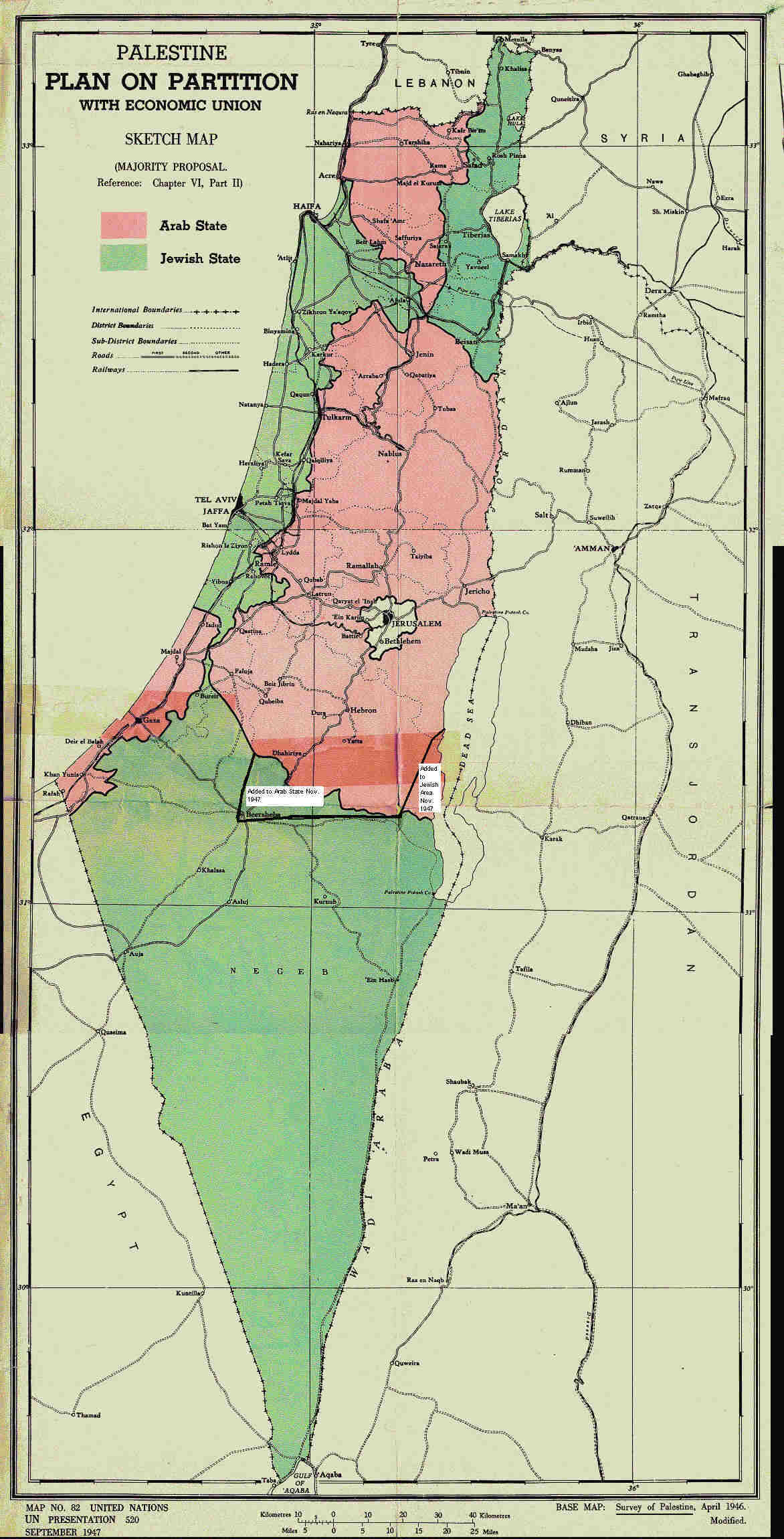
The map to the right shows the proposed partition of Palestine in 1947. The total population of the land at the time was approximately 2 million people of which 600,000 were Jews and the remainder were Palestinian Arabs. The partition plan, however, sought to give 55% of the territory to 30% of the population. Even within the territory allotted to the Jewish state -- the area in green in the partition map -- nearly half the inhabitants were Palestinian Arabs. This means that if such a plan was implemented, not only would a minority receive a majority of the land, but half the residents of the newly created Jewish state would either be transferred or disenfranchised from their right to self-determination.

When you look at the specifics of the partition, two very clear and important facts emerge: 1) No one in their right mind, putting themselves in the shoes of the Palestinians, would have accepted that deal, and 2) it is highly unlikely that the two intertwining "sausage-link"-shaped states proposed by this plan would have been conflict free.

Take a close look at this map and the borders. Have you ever seen anything like it anywhere else in the world? You probably haven't because such partitions do not work. And it wasn't simply demographic concerns that were at play here. The northern "sausage link" border was drawn to ensure that the railroad that went from Haifa to Beisan would remain completely under the control of the Jewish state. Ultimately, the vast majority of Palestinian villages along this route were depopulated and destroyed in the operations that David Ben Gurion made sure the pre-state government of Israel prepared for a decade earlier.

While the Zionist narrative might claim that the acceptance of this plan by Jews at the time and its rejection by the Palestinian Arabs shows Jews were willing to compromise and Arabs were not, in reality the Jews accepted the plan because they had everything to gain and the Arabs rejected it because they had everything to lose.

So it's rather disingenuous then, for Netanyahu or others like him who repeat the Zionist talking points on this partition plan, to attempt to justify Palestinian dispossession because Palestinians justifiably rejected their own dispossession.


read more...

May 16, 2011

Picking Apart the NYT/Zionist Narrative on the Nakba


Yesterday's deaths at various demonstrations commemorating the Nakba remind us of one all-important fact: without a just resolution to the Palestinian refugee issue, the state of Israel will never be welcome or accepted in the region. Those killed highlight the importance of a 63 year-old issue which has yet to be resolved or properly addressed. But it is impossible for there to be any just solution to this issue without a candid discussion of history that many "pro-Israel" types do not want to have. (Image right: AP photo of Israeli soldiers yesterday making sure people inconvenient to an ethno-centric majoritarian state stay out. Kind of like what NY Times editors do to facts inconvenient to the Zionist narrative.)

The Zionist narrative on the Nakba goes something like this: New born and defenseless Israel was attacked by 5 Arab armies the day after it's birth, and refugees may have been created during the fighting, but tough luck since the Arabs started the war and David defeated Goliath.

You can see this narrative uncritically repeated in the mainstream American press. Take for example this recent article by Ethan Bronner in the New York Times:

After Israel declared independence on May 14, 1948, armies from neighboring Arab states attacked the new nation; during the war that followed, hundreds of thousands of Palestinians fled or were driven from their homes by Israeli forces. Hundreds of Palestinian villages were also destroyed. The refugees and their descendants remain a central issue of contention in the Israeli-Palestinian conflict.

The timeline begins at May 14th, 1948. There are a few rather significant historical facts which are inconvenient for this narrative that go unmentioned in the New York Times. Well, at least today's New York Times. You see, had Ethan Bronner or the editors of the Times actually read their own newspaper's reporting on this issue at the time, they likely would not have presented such a distorted representation of the facts. (This certainly isn't the first time the NYT contradicts itself either)

Two facts which torpedo the Zionist narrative are corroborated by reporting from the New York Times during this period.

1. Masses of Palestinian refugees were created before one Arab soldier 'attacked' the new state of Israel. In one story from March, 20th, 1947, the New York Times actually addressed the pre-1948 situation as one of colonization and describes it rather appropriately. Imagining such characterization in the NY Times today is fantasy. I urge you to read the whole article, titled "Palestine Jews Minimize Arabs: Sure of Superiority, Settlers Feel They Can Win Natives By Reason or Force," but here's an excerpt:
Whatever the degree of their superiority complex, however, the Jews are certainly confident of their ability to bring the Arabs to terms - by persuasion if possible, by might if necessary. The program of the largest terrorist group, the Irgun Zvai Leumi, is to evacuate the British forces from Palestine and declare a Zionist state west of the Jordan, and "we will take care of the Arabs."
Despite this, the New York Times today repeats the ridiculous assertion commonplace in the Zionist narrative that the creation of the state was an innocent act that drew unprovoked and barbaric reaction from the Goliath Arab states. Here is another article, this one from April 16, 1948 and titled "Jews Press Arabs in Pitched Battle in North Palestine":
[Villages] taken yesterday were Dabiat er Ruha, Rihania and Kuteinat. Previously they had occupied Kufrin, Abu Sureik, Abu Shusha, Zerain, Naamieh, Ghubyat at Tahta and Ghubyat al Fauqha. Several bridges blown up by Haganah squads between Jenin and Lajjun are hampering Arabs [sic] communication.
But today's New York Times wants you to believe that the refugees created during the Nakba period, which is actually from 1947-1949, started only after Arab states attacked the newborn and sinless Israel. In reality, Zionist operations against Palestinian villages began well before the Arab armies crossed any borders. Half the total refugees created during the Nakba were created BEFORE May 15th, 1948.

A stream of Arab refugees is moving eastward across the Jordan river. Many of the refugees passing Jericho en route to Trans-Jordan, a few miles away, are from Jerusalem and Jaffa. They say they fear that Jewish offensives are crashing through weakened Arab volunteer resistance. Haifa was described as almost a ghost town, with its population having dwindled to less than 20,000 from a normal figure at least five times that.
Another article appearing in the New York Times titled "Palestine Strife Creates DP Issue" is dated May 3rd, 1948 stating "200,000 Arabs are now listed as homeless":
It is believed that possibly 50,000 Arabs left Jaffa, thousands of them by sea. Other thousands have fled inland, large numbers of them to become cave dwellers in the historic caves of Beit Jibrin, northwest of Hebron...at least 40,000 Arabs left Haifa when the combined Haganah and Irgun Zvai Leumi force stormed the Arab market place and conquered all of the city except the British-held waterfront. From Jerusalem wealthy Arabs have fled to near-by countries, the poorer ones into the hills and villages.
Another New York Times story, this one from April 18th, 1948, tells of horror among refugees and massacres in the Galilee:
According to reports telephoned from Nablus, that town and Jenin are crowded with refugees, among whom the rumor is circulating that the Jews are driving on Jenin. The Haganah said it had killed 130 Druse [sic] tribesmen yesterday when it seized Usha, a village east of Haifa.
This information is important not simply because it illustrates how poorly the New York Times' current day reporting is on an issue it reported on thoroughly at the time (They can't even copy and paste), but also because it clearly rebuts the Zionist narrative people like Jeffery Goldberg incessantly repeat despite mounds of historic evidence to the contrary. In this post, Goldberg argues that the Nakba was "self-inflicted" because the Arabs "attacked the just-born Jewish state and then managed to lose on the battlefield." Setting aside the already morally corrupt notion that ethnic cleansing during war is somehow acceptable, history simply proves Goldberg wrong. For a detailed account of the patterns of depopulation, you can see this video of Salman Abu Sitta's recent lecture at the Palestine Center, starting around the 10 minute mark.

2. The pre-state Israeli forces were far greater in number and far better equipped than the combined forces of the "Goliath" Arab armies. This is another myth in the Zionist narrative. They want you to believe that the 5 Arab armies had genocidal intentions and wanted to destroy Israel. Why else would you send 5 armies against one? But if the 13 nation-states of the Caribbean attacked the United States we'd hardly consider the United States the 'David' facing a Caribbean Goliath. But the Zionist narrative wants to trick you with a faulty numbers game. In reality, the pre-state Israel forces were greater in numbers and far superior in training than the combined forces of the infamous 5 Arab Armies. Conveniently, the New York Times reported in an article from Feb. 29th, 1948 titled "The Army Called 'Haganah'" :
Nobody knows its full strength, let alone its membership rolls. But it is no amateur army. It has a nucleus of 30,000 men who served in the British forces. Three thousand of them served in the RAF, including more than forty pilots. More than 300 served in the Commandos and 4,000 in the Jewish Brigade in action in Italy. The British estimate Haganah's active membership at anywhere from 60,000 to 80,000.
David Ben Gurion's war diary notes that at every stage of the war Zionist troops outnumbered combined Arab armies. The Arab armies where disorganized having little combat experience prior to this with the exception of some of the Jordanian forces. Most Arab soldiers were using outdated arms from WWI or earlier which were inferior to the Zionist armies WWII arms and artillery. But even though these are facts the New York Times told us back then, they don't want to remind you about it now. It makes you wonder; do the people that write the New York Times read the New York Times?

The depopulation of Palestine of its native inhabitants which took place from 1947-49 was commemorated this weekend and it was marked by Israel with the enforcement of ethnic cleansing. Palestinians seeking to return were shot down in the process. One reason that the Nakba is marked when the state of Israel was created is because the creation of this state meant that a political force would exist to enforce the exile of Palestinian refugees. 63 years later, we are reminded that that fear was very well founded.

Ironically, Israel is complaining to the United Nations that states like Syria and Lebanon would allow Palestinian refugees to come back to their native lands even though it is the UN which in General Assembly Resolution 194 required Israel to do just that.

Peace in the region will not come without an honest discussion of the events of this period, but it's a discussion the mainstream media doesn't seem to want to have.


read more...