Showing posts with label economy. Show all posts

Jan 31, 2014

ScarJo, BDS and the Economic Impact of Israeli Settlements

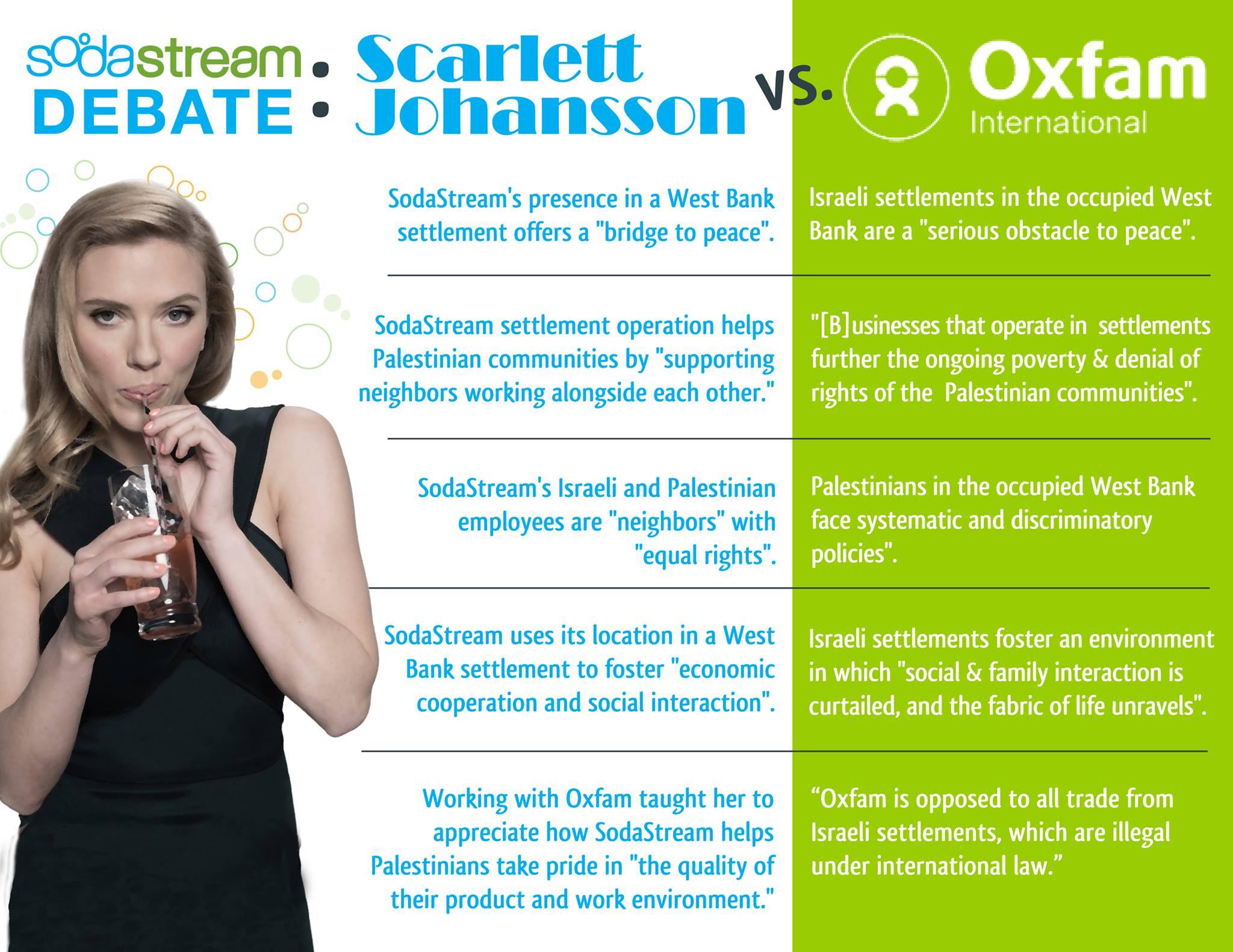
By now you have likely heard about the controversy over Hollywood star Scarlett Johannson and her love triangle between SodaStream, a company that manufactures products in an Israeli settlement and Oxfam, an international NGO that opposes settlements. The contradiction is obvious and for anyone still unclear, this info-graphic is helpful.

But one of the most pernicious responses in this debate from the anti-BDS crowd has been to claim that such a boycott would hurt Palestinian workers employed at SodaStream's factory in the illegal Israeli colony of Mishor Adumim. The long and dark history of colonialism is littered with this sort of thing. Some Europeans justified the treatment of Native Americans because they were "civilizing" them. We witnessed similar arguments in more recent periods of colonialism in Africa, for example. The notion that systems of oppression can be justified because of the limited and perceived gains that they may afford to a few while dispossessing them and most of their kin in a variety of other ways is not new.

Yes, a Palestinian working in a settlement may not otherwise have a job. Unemployment in the West Bank is above 20%. That the settlements and the system they are part of reinforce the economic realities that force Palestinians into choosing working within the very system that oppresses them.

Many Palestinians are confronted with the choice of seeking livelihood within this system or having no livelihood to speak of. This is a reflection of the captive labor market dynamics of the occupation. Palestinians should have the choice to work for and within their own independent economy but they don't. That is the problem here and it is a problem that is created, enforced and supported by Israeli settlements.

Yes, a small number of Palestinians may derive their livelihood from work on a settlement, but a much more significant number is suffering because of these settlements. To use the former to justify the later is absurd and yet it is precisely what Sodastream and the anti-BDS chorus has done in this case.

How do Israeli settlements impact the Palestinian Economy? The list is long and devastating but here are a few of the ways.

Land Confiscation - "Since the beginning of the occupation", notes this Btselem report, "Israel has taken control of hundreds of thousands of dunam [four dunam = 1 acre] throughout the West Bank, with the primary objective of establishing settlements and providing reserves of land for their expansion. It has done this by means of a complex legal-bureaucratic mechanism whose central element is the declaration and registration of land as "state land." In addition, Israel uses three complementary methods to seize control of land: requisition for military needs, declaration of land as abandoned property and the expropriation of land for public needs. In addition, Israel has also helped its Jewish citizens to purchase land on the free market for the purpose of establishing new settlements.67 Using these methods, Israel has seized control of some fi fty percent of the West Bank, excluding East Jerusalem" 
Restriction on Movement - "The establishment of Israeli settler-only roads and military zones" says Oxfam in this report on the Jordan Valley,  "means that many Palestinian farmers throughout the Jordan Valley are not able to access their farms. Tractors and other equipment are often confiscated, while herders are prevented from grazing their animals, which are often impounded for straying into a military zone. Palestinian herders must also buy wheat or barley to feed their herds, because they do not have access to their pastures.76 These significant additional costs incurred due to restrictions on access and movement are stifling production and driving many Palestinian households further into poverty. 
Restriction on Access- This World Bank report talks about the impact of Area C of the West Bank which is where all the settlements are located and is off limits to Palestinians: "Area C constitutes 61 percent of the West Bank and is the only contiguous land connecting 227 smaller separate and heavily residential areas. The 1993 Oslo Peace Accords stipulated that Area C be gradually transferred to the Palestinian Authority (PA) by 1998. This transfer has never taken place....With growth of approximately six percent annually needed to absorb new entrants to the labor market, let alone making a dent in the soaring rate of youth unemployment, urgent attention is needed to find ways to grow the economy and create jobs. A vital economy is essential for citizen well-being, social stability and building confidence to underpin the challenging political negotiations. However, the Palestinian economy, which currently relies on donor financed consumption and suffers from ongoing stagnation of the private sector, is unsustainable. The report estimates that if businesses and farms were permitted to develop in Area C, this would add as much as 35 percent to the Palestinian GDP. Freeing economic activity in Area C would have a particularly high impact on the development of businesses in agriculture and Dead Sea minerals exploitation, stone mining and quarrying, construction, tourism, and telecommunications. Other sectors would be able to benefit from improvements in the quality and cost of infrastructure and increased demand for goods and services. The volume of increased economic activity would greatly improve the PA’s fiscal position. It is estimated that government revenues would increase by US$800 million, which would cut the fiscal deficit by half, hence reduce the need for donor support, and reduce unemployment and poverty rates." 
Resource Usurpation- "For four decades",  states Amnesty International in this report, "Israeli military orders issued ostensibly to “protect” nature resources and reserves, including water resources, have had a crippling impact on Palestinian agricultural activities throughout the West Bank, while Israeli settlers, during the same period, have been given virtually unlimited access to water supplies to develop and irrigate the large farms which help to support unlawful Israeli settlements." 
Settler Violence - "Settler violence" says this recent UN OCHA special focus case study "has severely undermined the livelihoods of many families in this area, contributing to the relocation of some people in search of better livelihood opportunities elsewhere, including abroad. Those who continue to farm incur financial losses, partly because of difficulties in cultivating their land consistently, and because of the damage to their property or theft of their crops by settlers, in which case they lose both the money invested as well as the potential earnings from selling the crops."

There really is no debate about the impact of settlements on the Palestinian economy. The impact is devastating, in large part because of the reasons listed above. Anyone arguing settlements have had anything but a negative impact on Palestinians and their economy is either misinformed or disingenuous or both. Sodastream is part of this system and this system has done exponentially more to hurt Palestinians than anything else. 
read more...

Sep 21, 2010

Building on a Foundation of Occupation

As there has been a good deal of discussion and many would say unwarranted optimism about "Fayyadism", whatever that really means, it's important to look at analytical and scholarly perspectives on the economic situation in the West Bank and the role of the government in developing institutions.

Fayyad (pictured right here at a previous Palestine Center event giving this presentation) was in New York yesterday "speaking at a meeting with donor nations on the sidelines of the U.N. General Assembly" The AP story reported:
Palestinian Prime Minister Salaam Fayyad is appealing for more international aid, pledging continued reforms and vowing that his government will be ready for statehood "at any point" if additional assistance is forthcoming.
If you read that and thought there was an obvious contradiction between the drive for independence and drive for donor dollar dependence, well, your not alone.

In the spirit of Will's post earlier today I'll share with you some important insights on the issue of economy and governance relayed by experts here at the Palestine Center over the past year. They are lengthy but in-depth excerpts of presentations which are truly worth reading in their entirety to get a better grasp on the issue as a whole.

Oussama Kanaan
is the IMF Chief of Mission and Resident Representative for the West Bank and Gaza. In a presentation on the Palestinian economy at the Palestine Center earlier this year he stated:
So we have a really gradual moment of normalcy in the West Bank, a situation that is still very difficult in Gaza but overall, an improvement in living standards. Still, it’s important to emphasize that in terms of levels, the level of real GDP per capita, is still well below that which prevailed in 2000. So the growth, if you just talk about the growth story without putting it in context of an economy in which output is well below potential output in which you have a severe under utilization of resources, then it’s very easy to actually confuse this growth with a good health of the economy. The economy is still well below potential in terms of output and the basic needs of a large part of the population are still not covered.

Now in terms of the prospects, there were several articles which actually make it appear as if this relaxation of restrictions on internal movement and access is sufficient for the growth that was witnessed last year; about 7 percent to continue over the long term.

And if you look at our own studies, the message is very clear that two things need to happen for that growth to be sustained. First, that is based on the experience of almost all developing countries that have a small domestic market, all economies that have a small domestic market depend on the expansion of the export sector, for a sustainable growth in real GDP per capita. So no economy, according to the data that we have, no economy was able to grow in a sustainable way without its own export sector expanding. So simply by relaxing the restrictions on internal movement you could have, in the short run, an increase in growth just because the existing resources are better utilized. People are able to make better use of labor and capital to produce more output without necessarily actually reducing unemployment or reducing the investment rate. But just because people are able to trade from one city to another, for example, are able to have a normal life, whereby inputs can actually enter the cities and be used in production processes that were highly repressed to start with.

One important condition is the removal of the barriers on exports. First, the barriers on exports of goods and services to Israel have to be removed, this is the first condition. For an economy that does not have a seaport and an airport there is no other alternative, for this year I think, if you want to see a rate of growth that really is in the order of 7 percent. There is no alternative from having those barriers removed. Second, and as much as possible, the access to markets outside of Israel have to be encouraged. That is, we have to find a way in which in addition to access to Israel, exporters could trade with the rest of the world. This is an important element of the current two year plan by Prime Minister Fayyad where he is actually aiming at having a seaport, a functioning seaport [and] a functioning airport. Perhaps, this could not realistically be done this year but at least as an objective to be presented and to emphasize the importance of having an export market other than Israel.

Second, this is something that I think is not well understood by most people, 60 percent of the land of the West Bank cannot be used economically without permission of the Israeli authorities. That is the area, Area C. So 60 percent of the land is out of bounds for the private sector. I think if we want to see sustainable growth then it is important for that constraint to be removed. In Gaza – the blockade itself, the persistence of the blockade, even in its current intensity where some basic goods can enter, but still for such a small economy, if you want to consider the economy of Gaza as a sort of sub economy of a bigger Palestinian economy – you cannot have growth even in the order of 3, 4 percent in the long run if it remains under such tight constraints."
Another sobering analysis was presented at the Palestine Center by the then outgoing Palestinian Authority Minister of National Economy Bassem Khoury:
It is really amazing that although we received in 2008 two billion dollars in aid, direct aid, to our budget plus another one billion in aid in different forms; different NGO’s, UNRWA what have you. So you’re speaking of 800 dollars per capita that is 75 percent of our per capita was given in one year in aid to Palestine. Yet, in reality, per capita income declined in 2008. Why? In the West Bank we had growth of 7 percent. In Gaza we had minus 10 percent. The average was plus 2 percent. But population growth was around 3 percent so per capita income actually dropped. And to add insult to injury, our inflation rate was almost 10 percent. So in reality, Palestinians saw a worsening of their lives of almost 11 percent at a time [when] we received three billion U.S. dollars worth of aid. It’s a very big problem because this aid is there and we’re not able to benefit from it for a simple fact [that] we are unable to jump-start the Palestinian productive base and jump-start the private sector.

If you look at the figures, our productive base in 2008 was minus 32 percent of what it was in the year 2000 at a time when the population grew by 26 percent. So basically, we had a drop in our per capita production of almost 50 percent. This is why we were not able to benefit from the three billion dollars worth of aid. Basically, we get that money, the government spends it on salaries, on other running expenses. And what [do] we do with that? We buy with it goods and services mainly from Israel and from China. So this money in reality is there supporting more, unfortunately, the Israeli and Chinese economies than supporting the Palestinian economy.
Yazid Sayigh, a scholar of Palestinian politics and institutions, also had this to say about the economy and stability at a presentation this spring:
In the economy, here too there has been important stabilization of the situation in the West Bank, where the overall economy has grown modestly in 2008, more in 2009. And where the Israelis have reduced the amount of checkpoints and barriers within the West Bank sufficiently that it actually is now possible to move quite easily from Ramallah to Nablus or around to Bethlehem and further south in ways that were almost impossible about a year before. This has made a difference. But at the end of the day, the barriers have not disappeared and a lot of the internal closures are still in place.

More fundamentally, what I think is important here, is that the growth figure as a simple statistic, I think it was anticipated to be 7 percent. It’s more like 5 percent in reality. This is owed almost entirely to donor funding through the Palestinian Authority and public expenditure, not through private sector regeneration and growth. I think that is a very telling issue.

Banks in Palestine sit on about 7 billion dollars in assets. In other words, there is money there is not getting lent out because the private sector doesn’t have the assurance or the confidence that the investment will be returned. That it won’t be lost. So they are reluctant to borrow and the banks sit on that money. In other words, there are still very important structural obstacles in the West Bank to genuine economic development and growth which is, of course, the linchpin of donor strategy: improve economic conditions and the rest will follow. That didn’t work in the 90’s. It didn’t work after 2000 and it’s still not working. So there is stabilization but not genuine change.
Nathan Brown, of George Washington University and the Carnegie Endowment, discussed how economic support of the West Bank government is part of a policy that prolongs division between Palestinian parties:
Since June 2007, since the West Bank and Gaza split, American policy has been West Bank first, as Yousef was reporting at the beginning, essentially, figuring that the divergence in policy performance between the West Bank and the Gaza governments would solve the problem. That allowing some kind of level of security improvements, economic development and/or diplomatic process and the mix of those varies a little bit on the West Bank, and squeezing Gaza hard would make Palestinians come to their senses. That had essentially been American policy. Some of the mechanics of how this was supposed to happen, that is to say that if a Palestinian in Gaza thinks, “Gosh, this government is really bad in Gaza. Let’s get rid of it.”

How are they supposed to do this? I think that question was postponed. “Well, tomorrow will be another day.” There’ll be something that’ll make it clear or they’ll be elections and Hamas would be forced to run on a record of poor policy performance forgetting that the split made elections impossible. A new round of elections would not be possible unless there were some West Bank and Gaza reconciliation.
I should also note that Nathan Brown wrote this related and important piece last week.

So I think that the take away, in short, is that Palestinians don't need constant subsidization of their economy by foreign donor dollars. What they need is the independence to realize their tremendous potential. It's a bit absurd that Palestinians are challenged by Israel and the West to "build the necessary institutions for statehood" as if the Palestinians need to prove they are deserving, worthy or prepared for a state, after they were indispensable partners in building Amman and your pick of Arab states in the Gulf.

Instead, what we are seeing in the Palestinian economy, particularly in the West Bank, is the cementing of a system of perpetual dependence on foreign actors and in turn, a foreign policy making elite whose independence has been severely compromised by this very economic system.
read more...

The World Bank's Palestinian State


Today the World Bank published a report, 'The Underpinnings of the Future Palestinian State: Sustainable Growth and Institutions' (pdf).

Presuming success on the political track, the Bank's analysts naturally take an institutionalist and economics approach to the prospects of Palestinian statehood. They suggest that the viability of a future Palestinian state hinges on the strength of its institutions and its ability to sustain economic growth. The summary states optimistically:
If the Palestinian Authority (PA) maintains its current performance in institution-building and delivery of public services, it is well-positioned for the establishment of a state at any point in the near future.
However, no matter how well-developed domestic institutions are, external powers can always sabotage their inner workings. This is the central blindspot of two-state solution advocates. They fail to provide an explanation of how a Palestinian state would assure its own sovereignty.

The main points made by the World Bank's report touch on Palestinian dependence on foreign actors, but the Bank still presumes that a simple agreement, combined with institution-building and sustainable economic growth, is all that is needed for statehood.

The report's main findings, as outlined by the World Bank, are (my comments are in brackets):
  • PA spending remained within budget targets and improved collection rates resulted in higher than projected domestic tax revenue.
  • Progress on major reform initiatives strengthened the PA’s fiscal position (it lists examples).
  • The West Bank economy continued to grow in the first half of 2010 and the real growth rate, combined with Gaza, is likely to reach the projected 8 percent for the year. It notes that some of the increase in economic activity can be attributed to improved investor confidence and the partial easing of restrictions by the Government of Israel (GoI). The main driver of growth, however, remains external financial assistance.

    [In other words, outside funds are what's making the economic success story. This is an artificial growth. This artificiality is central to the optimism of the two-state solution, or the political program of Fayyadism, as named by Thomas Friedman.]
  • The sobering news is that despite the numbers, sustainable economic growth in the West Bank and Gaza remains absent. Significant changes in the policy environment are still required for increased private investment particularly in the productive sectors, enabling the PA to significantly reduce its dependence on donor aid.
  • The obstacles facing private investment in the West Bank are manifold and myriad, as many important GoI restrictions remain in place: (a) access to the majority of the territory’s land and water (Area C) is severely curtailed; (b) East Jerusalem -- a lucrative market -- is beyond reach; (c) the ability of investors to enter into Israel and the West Bank is unpredictable; and (d) many raw materials critical to the productive sectors are classified by the GoI as “dual-use” (civilian and military) and their import entails the navigation of complex procedures, generating delays and significantly increasing costs.

    [These barriers to private investment, it must also be noted, not only also involve infringements on Palestinian human rights, but are not likely to be resolved by any agreement between Israel and the Palestinians. And if they are, Israel will retain the ability to resurrect the obstacles, the equivalent of an axe over the neck of the Palestinian state. Its government will in effect be as accountable to its Israeli neighbor as it will to its own people and private sector -- a major check on the sovereignty of the state.]
  • Despite the reliance on foreign aid and reforms, despite its improved fiscal performance and expenditure control within budget ceilings, the PA still faces a shortfall possibly as high as US$300-400 million by year's end.

    [The PA's political program is being subsidized externally, which raise questions about control and direction. They also raise question about agency and the legitimacy of any agreement. In whose interests do negotiators ultimately act? It will be a mix of their own, their perception of their people's, while making sure to satisfy the paymasters and political overlords -- a recipe for disaster if there ever was one.]
The World Bank warns that without fundamental policy changes -- such as ending Israel's stronghold over the Palestinians (which went unnamed by the Bank) -- the PA will remain donor dependent and its institutions, no matter how robust, will not be able to underpin a viable state.

While it is correct to cite policies and practices as central, missing from this discussion is the problem of power and domination. In this sense, the World Bank's prescription is a de-politicized one. As with the famous joke of an economist assuming he has a can opener when asked how he would open a found can of food on a desert island, the World Bank assumes too much self-containment in Palestinian society. Taking Palestinian institutions and governance in isolation of the geo-political context is a deeply limited framework.

The World Bank's illusion is that a Palestinian state could ever be self-sufficient and free from fundamental external control and infiltration. Given the asymmetries between Israel and the Palestinians, the history of displacement and occupation, and Israel's on-going interests in keeping a Palestinian state de-militarized, weak and economically independent, how can a viable state be treated as a realistic outcome, or as an organizing concept for discussions of economics?

Sadly, it takes more than a vibrant business elite, construction, and good governance to make a state. It often needs minimal outside interference, something the Palestinians seem even further from in 2010 than they were in 1993.
read more...

Feb 3, 2010

Munayyer: Development Out of Context

Lavish, unrealistic plans for Palestinian development are a dangerous alternative to the struggle for independence.

By Yousef Munayyer
guardian.co.uk

Recently I received a very impressive full-colour booklet printed on expensive paper advertising a development project. The ambitious plan is to build a new Palestinian city, "Rawabi", in the West Bank.

The glossy images inside are not of the Palestine I know. The bulldozers are not demolishing homes, they are breaking ground to make room for the new city. Suited, Palestinian elites appear in lush boardrooms with international partners. The white, symmetrical buildings, typical of hilltop Israeli settlements, are instead part of the scale-model of the future development.

It's crafted for secular, western investors. Women pictured do not wear the traditional headscarf common among most Palestinian women, and the longest beard belongs to an Orthodox Christian priest. The booklet also portrays a Palestine sans occupation: independent and capable of securing investments.

The reality is radically different; Israel occupies the West Bank and blockades Gaza. Israel continues to control the West Bank through checkpoints and roadblocks that often arbitrarily close. Water is disproportionately dominated by a settler class that is privy to Jewish-only roads.

Rawabi may not even succeed. Its plot is surrounded by Israeli settlements and the roads which will connect it to other cities have not been approved by the ultimate authority over the territory: the Israeli government. Rawabi, itself, is not problematic. Rather the growing, fanciful discourse that it fits into, a discourse that emphasises development before independence, is the greater cause for alarm. This is evident in a new document by the Palestinian Authority (PA) entitled Palestine: Moving Forward about the vast institutions the PA seeks to develop to "establish the state of Palestine in two years."

But given the realities of occupation, the same realities ignored in the shiny Rawabi booklet, one has to ask: "Moving forward towards what, exactly?" With little change on the political front, exacerbated by expanding settlements, home demolitions in Arab East Jerusalem, and Israeli statements about retaining settlements deep inside the West Bank and controlling the Jordan Valley, it is hard to imagine these conditions foster a move forward at all. Instead, the development initiatives, in the actual political context, move Palestinians in three directions, and none of them are toward freedom from occupation:

1. Sedation – The development narrative temporarily assuages Palestinians who have long been living under occupation. Success stories about growth, increased wages, drops in unemployment and the sight of new buildings being put up in the centre of town eases people away from desperation. Israel facilitated this, to the extent that it suited their security, by permitting limited room for Palestinian development and growth in Palestinian cities in the West Bank. The measly economic success makes Palestinians hope for a brighter future despite the occupation. The masses were pulverised to the point that they have begun accepting the false choice between moderate quality of life and political freedom/self-determination.

2. Dependency – While most states wish they could escape the dependency curse, the institution-building initiatives outlined by the PA seem endanger the future economy of perpetual dependence. The economy in the West Bank is already highly dependent on Israel. Severed unnaturally from what was historically one economy, the West Bank will depend on Israel into the future. With no achievable state in sight to undergird the independence of a Palestinian economy through policy, Palestinian development is inevitably going to hit a glass ceiling structured by Israel interests.

Additionally, the document indicates that executing these plans requires exorbitant international investment. Only 25% of the costs are already funded, whereas 51% await international donor and investment money. International money comes with international strings. For a nation trying to achieve liberation, compromised economic independence will undoubtedly yield compromised political independence, making the struggle for a just resolution to the Palestinian question more difficult. Any state that accepts significant external support for domestic institution building should be concerned about its independence in the future – for stateless Palestine the concern should be even greater.

3. Division – The plan includes an important yet inconspicuous footnote regarding Gaza. Plans for Gaza's development will be implemented "after the Palestinian National Authority has the ability to do so". Until a political solution to Palestinian division is reached, development plans will go on in the West Bank and not in Gaza. Since such a deal seems remote, and the continuation of Palestinian division suits the interests of Israel, the dominating power, it is unlikely that change for Gaza is near. Therefore, the groundwork is laid for an increasing gap between the quality of life for Palestinians in Gaza and those in the West Bank, and also between a small, elite business class that stands to benefit from some projects and the majority of the Palestinian population that does not. The economic differences will permeate political and cultural dialogue as Palestinians in the West Bank will seek to live, while Palestinians in Gaza will seek to survive.

Development is not a bad thing. Every nation aspires to develop and build its political, economic and cultural institutions. However, a Palestinian national strategy of development that ignores the context of occupation and divorces itself from the struggle for independence is not only naive and irresponsible, but it may have dangerous implications for the future of Palestine and its people.

Yousef Munayyer is the executive director for the Jerusalem Fund and its educational program, the Palestine Center.

Views expressed on this post or on linked web pages do not represent the Palestine Center, the educational program of the Jerusalem Fund for Education and Community Development. All content is for educational purposes only.
read more...

Jan 22, 2010

The Palestinian Economy: Recent Experience and Prospects in 2010 w/ Oussama Kanaan, IMF

Dr. Oussama Kanaan
IMF Chief of Mission and Resident Representative
West Bank and Gaza

Friday, 22 January 2010


Download Video (mp4) [right click the link and select 'save link as']

Download Audio (mp3) [right click the link and select 'save link as']


TRANSCRIPTS
read more...

Jan 15, 2010

Talk on Palestinian Economy, January 22.

The Palestinian Economy: Recent Experience and Prospects in 2010

with

Dr. Oussama Kanaan
IMF Chief of Mission and Resident Representative
West Bank and Gaza

Friday, 22 January 2010
12:30 - 2:00 p.m.
The Palestine Center
Washington, DC

RSVP

This event will be webcast on this website, www.palestinecenterblog.org at 1 PM EST.

While economic conditions have improved in the West Bank, the conditions in Gaza continue to worsen after months of siege and devastating attacks and incursions. Largely, economic conditions in the Occupied Territories are greatly controlled by outside powers -- directly the Israeli occupation -- and the donor nations which contribute aid money. Economic growth, without independence, continues to be tied to a relaxation of restrictions and an influx of donor dollars. Join us for a discussion on the economic conditions in Palestine and their prospects for change in the coming year with Dr. Kanaan.

Dr. Oussama Kanaan is the IMF Chief of Mission and Resident Representative for the West Bank and Gaza. He has worked at the International Monetary Fund since 1993. He is the author of numerous publications which include articles in economics particularly applied to countries in the Middle East (including the West Bank and Gaza) and the peace process. He holds a Ph.D. in economics from Yale University.
read more...

Oct 30, 2009

VIDEO/TRANSCRIPT: Economic Conditions and the Future of Palestine


"Economic Conditions and the Future of Palestine"

with

Bassem Khoury, the former Minister of National Economy for the Palestinian Authority (PA). He recently spoke at the Palestine Center in Washington, DC on the current and future economic conditions in Palestine.

29 October 2009

Download Video (mp4) [right click the link and select 'save link as']

Download Audio (mp3) [right click the link and select 'save link as']

Edited Transcript of Remarks by Mr. Bassem Khoury
Transcript No. 319 (3 November 2009)


Mr. Bassem Khoury:

Thank you, Yousef. Ladies and gentlemen, good afternoon. I would like to first start by thanking The Jerusalem Fund for giving me this opportunity to address this forum again. Last [time] I was here was almost eight years ago and it is really nice to see that this organization is really growing. And what I see in front of me is really admirable.

It’s been eight years since I was in Washington and what a sea of change we are seeing. The question is, “How can we Palestinians and Arabs benefit from the opportunity that we will have with this administration?”

A little bit of history: For us Palestinians, this conflict is a basic conflict over our basic rights as a people, most notably our legitimate aspirations to establish a viable, independent [and] sovereign state living in peace and harmony with all its neighbors and, of course, Israel being foremost among those neighbors.

Back in 1988, we Palestinians recognized Israel. The [Palestine Liberation Organization] PLO, as a representative of the Palestinians, did so and we have repeated to do so several times ever since. Doing this, we consider ourselves the indigenous to the land, have relinquished claims on 77 percent of historic Palestine and accepted the 23 percent remaining as a homeland. I, myself, am a refugee. I come from the Galilee, from a village near Nazareth. Like a majority of Palestinians, I have accepted this historic compromise and I would like to look to the future. However, this wrong wing Israeli government has to take a similar historic decision and recognize the right of the Palestinians to establish, alongside Israel, a state on the 23 percent remaining, of course, with East Jerusalem as a capital. Attempting to instill changes on this border, will open the door for many, on our part, who will demand alterations. Thus, I believe, the 1967 border known as the Green Line, is really the red line.

Today, over 400,000 Israeli colonialists live in Occupied Palestinian Territory. I would like to stop here just for a second to outline the importance of terminology. They are not settlers. They are colonialists. Because when an occupier occupies an area he brings in people to live there and he builds colonies. He doesn’t build settlements. And it is not Occupied Palestinian Territories. It’s Occupied Palestinian Territory. It’s one united territory with one fate. When you speak of territories, it means that a territory can be kept, another territory can be negotiated and another territory can be given up like what they did in Gaza. No, it is one united territory and the fate of this territory—and this is by definition in [the] Oslo [Accords] and other international documents. And, of course, there’s no left wing and right wing [Israeli government]. In our situation, there is a correct wing and the wrong wing. And I believe that the current Israeli government is the wrong wing government. So, around 400,000 Israeli colonialists live in Occupied Palestinian Territory in some 170 colonies, in contravention to international law. More than 40 percent of occupied West Bank is controlled by the colonial enterprise, including: the colonies, the bypass roads, the Wall, the checkpoints and other related infrastructure. The whole world realizes and recognizes that this colonialist enterprise is the single greatest threat not only to the establishment of a viable Palestinian state but also to peace in the region.

In order to salvage what remains of the credibility of the peace process, what is urgently needed is a freeze in the building of the colonies. This has to be a comprehensive freeze that will apply to all [of the] territory, including East Jerusalem, and has to be implemented as fast as possible. And this is something that is a prerequisite if we are to have a credible peace process. Of course, the whole world recognizes this although lately we’ve seen some changes in the [U.S. President Barack] Obama administration’s use of terminologies. However, the Israeli wrong wing government still is not in support of this and they are pushing forward [with] what they call economic peace as an alternative to political peace.

It must not be forgotten that this notion of economic peace has been tried several times before and failed. The whole essence of Oslo was economic as this interim agreement was basically focusing on economic issues and left all major and important issues to the final status: Jerusalem, settlements, borders, refugees, etc. It was hoped that the economy will be used as something that could uplift the political process. That once we could succeed economically, maybe Palestinians and Israelis will find it easy to negotiate a political solution. Unfortunately, we Palestinians did not benefit from the peace process as illustrated by the per capita differentials. If you look at our per capita income when Oslo was signed and compare it to that of Israel, you’ll see that the Israeli per capita income was eleven times that of Palestine. After five years of peace we saw an increase in that differential instead of a decrease. It grew actually to thirteen folds. Now it is closer to 25 folds.

I believe that the Paris Protocol, which was basically an interim agreement between us and the Israelis, did not work and the reason is very clear. Usually, when you have a customs union between two entities, one which is a stronger economy and the other one which is a weaker economy, the customs union always favors the stronger economy. We Palestinians accepted this economic arrangement for two main reasons: one, maintaining the access of Palestinian labor into Israel. As you all know, we had something around 150,000 employees, day laborers, who were crossing the border into Israel each day getting us anywhere between five to eight million dollars on a daily basis. And the other thing is maintaining access to Palestinian products, mainly agricultural products and agro industries, into Israel. In breach of the Protocol, Israel started implementing major restrictions on both these issues way before the second intifada. By Israeli design, the economy of Palestine was always meant to be kept hostage. And, of course, the list is long. We can discuss this, if you’d like, at length in some other time.

All international reports indicate very clearly that the main obstacle to Palestinian economic recovery is what is termed [as] the “closure regime” as demonstrated by restrictions on access of movement in the West Bank by around 550, 600 road blocks, checkpoints, etc., the closure of Jerusalem and the isolation of Jerusalem from its natural surroundings and, of course, the closure on the Gaza Strip. These restrictions as the World Bank report of May 2007 clearly states, do not serve Israel's security. But their main objective, and using the exact terminology of the World Bank, "is to re-enforce the Israeli settlements". Actually, in May 2007, [Paul] Wolfowitz was heading the World Bank and, I for one, sent him a thank you note for allowing the publication of this report because this was the first report ever by a credible international organization that links the closure regime to settlements. And basically stating that unless we can move on settlements, unless we can move on the political issue, symbolized and being practiced which is the colonization of Palestine, we will not be able to move on the closure. As such, we will not be able to move on the economy. This is the direct linkage that was very clear in the report between the economic track and the political track. This is why our per capita income did not grow. This is why the differential grew now to 25 folds. So an Israeli now makes 25 times what a Palestinian makes in terms of per capita. And this is why our per capita income continues to shrink. It is now 35 percent of what it was in 1999 due to the closure regime.

The closure regime has divided Palestine into three areas. The Gaza Strip, which lives under a deadly siege. It is economically in shambles. Over 3,500 industrial establishments are closed with very little potential for recovery under the current situation. This is a maximum security prison. The West Bank, which is, in a way, a living proof of what we Palestinians given even a small chance--what we can do to our life and to our economy--is dynamic despite of the occupation. And this is not unfortunately the case with other areas. So this is a medium security prison. And then you have East Jerusalem. It has been separated by Israeli policy from its natural markets, while ensuring that it does not develop into the same levels as on the Israeli side. And this is something we will be discussing with more detail in the presentation. Thereby, what has been created in Jerusalem is a ghetto that is tied economically to an economy it is not compatible with and separated from the Palestinian economy, which is its natural extension of.

It is really amazing that although we received in 2008 two billion dollars in aid, direct aid, to our budget plus another one billion in aid in different forms; different [Non-governmental Organizations]NGO’s, [United Nations Relief and Works Agency]UNRWA what have you. So you’re speaking of 800 dollars per capita that is 75 percent of our per capita was given in one year in aid to Palestine. Yet, in reality, per capita income declined in 2008. Why? In the West Bank we had growth of 7 percent. In Gaza we had minus 10 percent. The average was plus 2 percent. But population growth was around 3 percent so per capita income actually dropped. And to add insult to injury, our inflation rate was almost 10 percent. So in reality, Palestinians saw a worsening of their lives of almost 11 percent at a time [when] we received three billion U.S. dollars worth of aid. It’s a very big problem because this aid is there and we’re not able to benefit from it for a simple fact [that] we are unable to jumpstart the Palestinian productive base and jumpstart the private sector. If you look at the figures, our productive base in 2008 was minus 32 percent of what it was in the year 2000 at a time when the population grew by 26 percent. So basically, we had a drop in our per capita production of almost 50 percent. This is why we were not able to benefit from the three billion dollars worth of aid. Basically, we get that money, the government spends it on salaries, on other running expenses. And what [do] we do with that? We buy with it goods and services mainly from Israel and from China. So this money in reality is there supporting more, unfortunately, the Israeli and Chinese economies than supporting the Palestinian economy. Unless we can jumpstart the productive base of the Palestinian economy, to be honest, we have no future. We will always be dependent on aid and Palestine will be a failed state; another Somalia, unfortunately. And I’m sure we have not fought and struggled for a Palestinian homeland that will end up [as] another Somalia. So the real key is how can we really jumpstart the economy and ensure that the productive base of Palestine increases. This situation now is as if you’re trying to heat or air condition a room in the middle of the winter with all the doors and windows open. So no matter how much you have the boiler running to heat the room, you will never get it warm enough. We have to think of how we can jumpstart the private sector properly.

Since the so-called economic peace does not address the root causes of the conflict, which is political and not economic in nature, it simply will not work. A removal of one checkpoint here or one checkpoint there will not suffice. Only dismantling the closure regime altogether in the West Bank, including East Jerusalem, and lifting the siege over Gaza while allowing [a] territorial link between the West Bank and Gaza will be able to alleviate the economic conditions in Palestine. We need this change as fast as possible because it is important to change the fundamentals and the playing fields if we are serious about really having peace.

The siege over Gaza is both a crime and a shame. We Palestinians were allowed up until last Thursday, a week from today, only 34 items to be entered into Gaza. So we are allowed for example, sugar but not coffee or tea. We were allowed flour but not yeast to make bread. Our [Value Added Tax] VAT revenues, our tax revenues from Gaza as a [Palestinian Authority] PA, dropped by more than 95 percent. By the way, Israel made this historic compromise and allowed last Thursday coffee and tea into Gaza.

But have no illusions. Everything is available in Gaza. The tunnels are working very nicely. If you’d like, I can send you a copy of the picture of a car my office bought in Gaza. The car was smuggled through the tunnels. But, of course, everything is for a price. The current administration in Gaza is sitting on the tunnels collecting taxes. So as a result, if you want to have the best chocolates, yes, you will have them, but for a price. And who is benefiting from the status quo? Who is benefiting from this? The current administration that is in Gaza. Israel is doing this out of design. It’s not doing it because they are making a mistake. They know it. The international community has repeatedly told them. I myself have discussed it with various U.S., European, etc., etc., people who visited, top notch foreign ministers, presidents, congressmen, senators, several times. I think what Israel is doing is by design because they would like to keep the status quo in Gaza. They want Hamas to be there strong in order to control but not strong enough to throw missiles. At the same time, they would like to keep the PA in the West Bank weak. They would like to keep us divided as Palestinians. As a result, they will come and say we have no partner. That there’s nobody we can talk to; the Palestinians are divided, not in control. This is why the only way out for us Palestinians is our national unity. Anybody thinking that we have a future any other way is simply pursuing an illusion. We have to push for national unity. We need your help in insuring that an election does take place in Palestine. There is now talk of an election in January if there is no consensus and, if there’s consensus between the two parties, in June. We need the international community to be behind Palestinians on holding those elections. We need your voice and you to push the U.S. administration to facilitate these elections; to accept them and also to push Israel to ensure that there is an election all over the Palestinian territory, including Jerusalem.

Our commitment to Gaza as a government has been strong and will be continued. Every month we send into Gaza 120 million dollars. This is basically to sustain the population that is living in the siege. Eighty percent of the population of Gaza still lives under the poverty line. So this money is there to give them a lifeline, to support them. Fifty-four percent of the budget of the PA is spent in Gaza. We spend in Gaza more than what we get—in 2009 we will be spending more in Gaza than we’ll be getting in aid. So basically what’s happening in Gaza, these Israeli actions, are happening due to a well designed plan and it’s basically, again, as I said earlier, it’s because Israelis don’t want to pay the price for peace.

We are proud of the fact that in spite of the difficulty we’ve had economic growth in the West Bank in the past two years. We’ve had that for three reasons. One, the government managed to instill law and order. Those of you who remember Palestine two, three years ago, it was almost impossible to go to various cities like Nablus or Hebron. We’re very proud of the fact that now, [in] those two cities and the rest of the West Bank, life is normal and there is law and order. The second thing, we’ve had a government that was able to engage with the world and able to receive aid from the world. And number three, the disbursement of a massive stimulus package totaling around 20 percent of the [Gross Domestic Product] GDP, around 800 million dollars. This came in three forms: an income tax reduction that kicked in, payments of back arrears to the private sector and back payments of back arrears to the government employees. We’ve had in 2008 a stimulus package almost a full year before the whole world started thinking of stimulus in 2009. This is why we’ve had growth in the West Bank, not because we have jumpstarted the productive base or the private sector. We’ve had growth because we’ve increased consumption. If you look at 2009, things are looking even better. We expect to have around 9 percent growth in 2009. Gaza will shrink by 1 percent. Inflation is only 2 percent. So for the first year since1999, 2009 proves to be the first year that we’ll have a net increase in GDP in Palestine. So, at least it’s a step in the right direction.

However, if the restrictions resulting from the occupation are not lifted in the immediate future, and in order to maintain the current rates of growth, we will need higher assistance levels. This is, of course, not possible since as you all know the world is going through an economic crisis. It’s not possible for us to maintain the same assistance. It’s important to note that the assistance levels in 2009 were actually much lower than those of 2008. And we will need around 250 million dollars just in the next three months, till the end of the year, to sustain us through the year. Therefore, this level of growth cannot be repeated unless the Israeli restrictions are lifted. The private sector, therefore, must be allowed to work properly, in order to sustain these levels of growth. It is clear that the work of the Palestinian government under the leadership of [Palestinian Authority] President [Mahmoud] Abbas is the real underlying reason for the current spurt of economic growth in the West Bank, and not what Israel is trying to claim is economic peace.

It really is amazing that the Israeli government says that their actions of lifting some of their restrictions on the Palestinian economy is the reason why we’ve had this growth. I mean, we’ve had growth in 2008 and this wrong wing Israeli government was formed in mid 2009. How can the growth that took place in 2008 be explained by actions taken by this wrong wing Israeli government in 2009 is really beyond me. It’s amazing how Israel always pushes the agenda in the wrong way.

Israel maintains that the closure on Gaza is due to [Gilad] Shalit. I think it is very important to remember that Shalit was kidnapped in June 2006 and the closure on Gaza was imposed in June 2007; one whole year after Shalit was kidnapped. So, the closure on Gaza has absolutely nothing to do with Shalit.

The Chinese proverb says ‘it is better to teach people how to fish than to give them fish’. We Palestinians say very clearly we know quite well how to fish. We need an opportunity to do so. The famous Palestinian economist, Dr. Yousef Sayegh once said, "Give us a state with sovereignty, and we will build a sustainable and prosperous economy". We need to increase the Palestinian private sector’s access to the outside world. We need to increase its access to technology and access to finance and we need to be able to engage with international players in accordance with internationally recognized rules of trade and investments. This is why I went to Geneva, almost a month ago, to advocate for Palestinian observership at the [World Trade Organization] WTO. And to be honest, when I heard the official response of the Obama administration that they are not willing to support our observership in the WTO, of course under pressure from Israel, even though all the world—we met with all the different trading blocks in the world, from [North American Free Trade Agreement] NAFTA to the [European Union] EU to [the] Arab group, the Muslim group—you name it, everybody—Latin Americans, Caribbean’s, what have you--everybody told us they supported our accession except two countries unfortunately; Israel and the United States. Even Japan, even Canada, etc. What is really bad is that accession as observers was granted to us by the [former U.S. President George W.] Bush administration. There was an agreement that we would participate as ad hoc observers in the Hong Kong ministerial conference of 2005 and then after that we would be accorded accession. Unfortunately, the Obama administration is going back on something elementary--basic--that the Bush administration had promised us.

It is really unfortunate that the occupation has become comfortable with the status quo. It is happening due to the benefits that the Israeli business community is reaping from the occupation. This is why they are not willing to let go. As the late mayor of Bethlehem, Ilias Fraj, once said, “We cannot live in this state of limbo, whereby we do not know if we are married or divorced, but are being used as a mistress out of wed-lock”. We are not looking for a state under occupation. We are not trying to make the occupation look better. We don’t want a state with provisional borders or a provisional state. Clearly put, we definitely do not want a failed state. What we want to ensure is that a state of Palestine comes into being as a peaceful, democratic, pluralistic, sovereign and economically viable [state]. What we really want plainly is a normal state.

The status of the moderates in Gaza, the West Bank, and Jerusalem and inside Israel proper is truly worrisome to me. It is very clear that when you declare an area as a terrorist entity it is a self-fulfilling prophecy.

The last days of the Gaza war when the military operations were winding down, Israel sent its bulldozers to make sure the job that was started by its planes was “fully completed”. Not only did they destroy factories—by the way, Human Rights Watch will be publishing a report at the end of this month specifically on that, the destruction of industry during the last three days of the war. I, with our staff in Gaza, as the president of the Federation of Industry, we did the field work, the studies, and it is amazing that more than 50 percent of the destruction actually took place on the last three days of the war. Not only did they destroy the factories with their bulldozers, but also the only secular school catering to the children of the elite in Gaza, which is the American School of Gaza. They were all completely bulldozed. The message to the moderate core was very clear and loud: you have no place here. No jobs, no schools for your children. Go elsewhere. It is really bad and sad that almost all the people from the private sector, the major players that I know, that I have been working with for years, have picked up and left. How we will be able to pick up the pieces now is really beyond me.

What the next generation in Gaza and in Jerusalem and, to a lesser extent, in the West Bank is being taught is really worrisome to me. According to UNRWA, the UN agency, the children of Gaza are much more extreme now than their parents. When a siege is imposed, people turn inwards. More than 99 percent of the population of Gaza does not know anything beyond the walls of the Gaza ghetto prison they are living in. The situation in Jerusalem is not much better. I usually don’t work on Sundays. At least now, when I was a minister I had to work on Sundays. But I’m looking forward for the break on Sundays now. My home in Jerusalem is right next to a school and I’m awakened every morning with the speech that the principal gives and what the children are expected to repeat after him. What the children are being taught in Palestine, in Jerusalem today, is definitely not moderate core thinking. This is not Gaza I am describing. Gaza is even much worse.

We do not have ‘til eternity, we have wasted already too much time and the reality is that the window of opportunity is actually shrinking. To miss it now will ensure that we are alienating what is remaining of the moderate core of Arab and Muslim societies and of Palestinian society and will for sure usher in more extreme leaders who are not willing to negotiate. So my question, wide and clear to Israel is, Israel make up your mind. No more [of] this immoral and illegal out of wedlock relationship. Either marry us or let us go. Either a two-state solution or a one-state solution. But to maintain it like this is simply impossible. And, of course, to Israel I say the choice is yours.

Three years back at a breakfast in Jerusalem with [U.S. Congresswoman] Nancy Pelosi and a group of congressmen, I was asked to make a five minute speech. So I spoke about the economic situation in the West Bank and Gaza and of course on the situation of income differentials between us and Israel, etc, etc. A congressman who was sitting next to Ms. Pelosi automatically said you should stop throwing rockets before you can expect the economy of Gaza [to] pick up. And then he went on and on that he was in support of all Israeli policies and he made a mistake of saying that of course we support for Jerusalem to remain the eternal undivided capital of Israel. So I asked him in a very stupid fashion, “And how many rockets fell on West Jerusalem from East Jerusalem lately?” He was simply dismayed and he said, “What are you talking about?” So I asked Ms. Pelosi and the rest if I can give them some of the socioeconomic data of Jerusalem; a city that has been annexed by Israel in 1968 and a city where supposedly Israeli law is applied. So I would like to give this simple presentation. In my premise, which you’ll see at the end, that what we’re seeing in Jerusalem today is basically a new Gaza in the making.

[PowerPoint presentation begins]
As you all know, Israel annexed Jerusalem in 1968 and proclaimed it as the “united capital” that should remain till eternity. But, in reality, the socioeconomic figures reveal that it’s a city increasingly divided. The following slides deal with the socioeconomic situation of West Jerusalem including the colonies that were built in East Jerusalem versus the Arab East Jerusalem. The data is collected from the 2007 Israeli Bureau of Statistics. So this is the official data. Unfortunately, the trend continues to get worse. I was looking yesterday at the data that was published yesterday in a new study done by the Macro Center, this is an Israeli center for political economics, and actually this trend continues to get worse. The Macro Center, and here I quote, “Israel has expropriated some 35 percent of East Jerusalem territory despite the fact in 20 years the majority of the Jerusalem population will be Palestinian.” So in 20 years we will have in greater Jerusalem a Palestinian majority. By Israeli policy, Israel has isolated Jerusalem from its natural surroundings and separated it from its strategic depth while ensuring that it does not develop into the same levels as on the Israeli side. Thereby creating a ghetto that is tied on an economy it is not compatible with and separated from the Palestinian economy which is its natural extension of.

So if we look at per capita in Jerusalem quickly, per capita income for an Arab is around six thousand shekels compared to a Jew which is around 14,500. So basically, the per capita income differential is almost 2.5 times. Unemployment in Jerusalem for the Arab population is 25 percent. It’s much higher than the rate in Ramallah or Bethlehem which is 15 percent. Actually, now it is lower than 15 percent. Ramallah, last statistics, the unemployment is down to around 10 percent. Only 15 percent of Palestinians find employment in Jerusalem.

Infant mortality for an Arab versus a Jew; 7.2 per thousand while it is 4.2 per thousand for the Jews. Of course, all healthcare is supposed to be under one system.

Population:the 251,000 [Arab] population of Jerusalem has 106,000 children while the Jewish population of 495,000 has 158,000 children. So basically, we have 42 percent of the child population of the greater Jerusalem. However, this 40 percent of the Jerusalem child [population] has only 15 percent of the education budgets while the Jewish sector, the 60 percent, has 85 percent of the education budgets. So per capita, on the Jewish side, they’re spending 3.87 times what they’re spending on the Palestinian side.

Poverty: Jerusalem, by the way, is the most impoverished city in Israel when you compare it to Haifa or other places. Of the 251,000 [Arab population] you have 125,000, almost 50 percent, living below the poverty line. [On] the Israeli side you have 495,000, there’s 123,000 living below the poverty line. So in absolute terms, we have more Palestinians living in poverty in Jerusalem than Israelis. Poverty and welfare budgets; as you see, the 125,000 [Arab population] receive only 12 percent of the welfare budgets. However, the 123,000 [Jewish population] receive 88 percent of the welfare budget. So the differentials there are 7.45 times. How can a Palestinian child who needs welfare be less deserving? I really don’t know.

Municipal budgets: the 34 percent of the [Arab] population receives only 8 percent of municipal budgets, as compared to 92 percent of the budgets received by the 66 percent [of the Jewish population] so the differential there is 5.93. Sewage network; we receive 11 percent while the Israeli side has 89 percent. So the differential is 4.17. Garbage collection; of course who needs garbage collection? We only get 7 percent and they get 93 percent. That’s why if you go to Jerusalem it’s very easy to differentiate an Arab neighborhood from a Jewish neighborhood. Road networks; we get 13 percent, they get the rest. So the differential is 3.79. Sidewalks; we get 9 percent. They get 91 percent. No need for walking or jogging. It’s 5.2, the differential. Public gardens; we get only 3 percent. They get 97 percent. It’s 16.66, the differential. The cultural budget is 1.2 percent for the Arab sector versus the 98.8 percent for the Jewish sector, 42.42.

If you look at all the differentials, you see that Jerusalem is a city that is only united in apartheid. Forty two years of occupation, 41 years of annexation and you can see that the gap actually between differentials is widening. We compared, in a study, that at the time of occupation actually the situation in Jerusalem, in many aspects in East Jerusalem, was better than that in West Jerusalem. Anyone who’s supporting a united Jerusalem as the eternal and undivided capital of Israel is condemning us Palestinians to live eternally under apartheid. This was my message to Nancy Pelosi and her colleague.

And this is my message to you. I would like this to be made very clear. We Palestinians have three requests from you. Number one, there is now an attack on Jerusalem. Israel is intensifying its effort on Jerusalem. Not only in the Al-Aqsa mosque area but everywhere; house demolitions, ethnic cleansing, etc, etc. We need to all stand up. This is the Jerusalem foundation. Your name was coined in order to do something for Jerusalem. This is the time that you are needed most. Number two, we need you to ensure that you support Palestinian unity because the only thing that could come out of the current situation is more problems for us Palestinians. This is the gift that we are giving to Israel, this disunity of Palestinians. And, of course, number three, we need you to ensure that we together can get an election going. We are proud of the fact that we are the only country in the Arab world that had two elections that are fair and square; that nobody can say had any flaws. And we would like you to help us ensure that our democratic tradition is continued, that there will not be a constitutional void coming. And lastly, this morning I was in congress and I spoke to one congressman about an upcoming resolution to be taken by the U.S. congress condemning the Goldstone report.

[Richard] Goldstone, for those of you who don’t know, is a famous, Jewish Zionist judge from South Africa who did reports on human rights abuses, on war crimes in various parts of the world; in ex-Yugoslavia, in Africa--Rwanda, Darfur and elsewhere. Goldstone was asked in January by the UN Human Rights Council in Geneva to go and investigate. The funny part is that congress wants to condemn the investigation--that he shouldn’t have investigated. You know, to me, who is worried about an investigation? Only a guilty [party] is worried about an investigation. So Goldstone started to embark on his work. Israel was very clear and said that they will not cooperate with him. Of course, there are voices in Israel today that are saying we made a mistake. The report of Goldstone was very balanced. It spread the blame and it said clearly that both sides committed what he thinks are war crimes even though Israel acted in self-defense. But its actions in self-defense still crossed red lines and constituted war crimes. And Goldstone basically recommends and asks the different parties to form independent commissions to investigate what happened. Failure to have these investigations will definitely open the door wide open to all sorts of litigation against the different parties. What is really amazing is that congress is now thinking of passing a resolution that condemns the report, that condemns the language of the report, but more importantly, condemns the language of the resolution adopted in Geneva two weeks ago. Reviewing the language of the resolution, it is identical to the same resolution language that passed when it was on Darfur, when it was on Rwanda and when it was on Serbia. How the language is deplorable when it comes to Palestine-Israel and the language is okay of a resolution when it comes to other places of the world is really beyond me. Secondly, if Israel is so sure it did nothing wrong, why not allow an open investigation; a credible one that is independent, that would come and either say, no you committed war crimes and the guilty should be punished or it will come and clear Israel of those charges. But to come and say that we condemn the report and we are not willing to be part of that report is not something that I think is right. It’s not right for Israel. It’s not right for Palestinians. It definitely is not right for the U.S. and for the Obama administration which claims to have opened a new page in relations with the Arab and Muslim worlds.

As you know, I resigned my post over the handling of the Goldstone [report]. I did it in silence. I never wanted this to be an issue that will be used against the PA. After all, I’m proud of the fact that I am part of that establishment. I’m not on their payroll but I am a Palestinian who is proud of our legitimacy, who is proud of our elections. And, as a result, we have an elected leader. So you have to stand with him. Right after that, I went to Geneva. I got a legal opinion on how we should tackle Goldstone. And I’m very proud of the fact that I advocated that. And at that exact moment, two o’clock in the afternoon when Hassan Abu Libdeh was sent by the prime minister to hand me the letter accepting my resignation, was the exact same moment we were discussing the Goldstone report again. By the way, it passed with more votes than we thought we will have the first time. I’m happy this is done. I believe the Goldstone report is a way that should set a foundation of future relations between us and the Israelis. Israel always thought they could do whatever they want and they will have impunity. For the first time ever, there was a situation whereby somebody came--a Jew, a Zionist, a credible person--came by and told them what you did was wrong. And I am sure, hopefully we will never have a next conflict, but I am sure the next time we have a conflict in the area, Israeli generals will think more than twice before giving orders to commit war crimes.

Thank you very much for today’s event. I really enjoyed it. I’m very happy, again, to be back. Hopefully, we will see you shorter than eight years. But something that is positive that is happening -- again, I would like to end on an optimistic note--I believe we do really have a chance with this administration. We Palestinians, Arabs and Muslims, should think how we can really move this administration in our favor and how we can really benefit from this window that is opening for us. Thank you very much. I salute you and have a good day.

Mr. Bassem Khoury is the outgoing Minister of National Economy (MoNE) for the Palestinian Authority in Ramallah.

This transcript may be used without permission but with proper attribution to The Palestine Center. The speaker's views do not necessarily reflect the views of The Jerusalem Fund.
read more...

Oct 26, 2009

EVENT: "Economic Conditions and the Future of Palestine" with Mr. Bassem Khoury

Thanks for viewing the live stream of this event. The video and transcript will be posted here.

Click here for the slide show presentation

Thursday, October 29
12:30 pm - 2:00 pm

The Palestine Center
2425 Virginia Ave, NW
Washington, DC 20037
202.338.1290


Bassem Khoury is the outgoing Minister of National Economy (MoNE) for the Palestinian Authority in Ramallah. He recently resigned his post, citing the government’s handling of the Goldstone Report in Geneva. Before his appointment, the Minister was Chairman of the Federation of Industries. He founded the Palestine Insurance Company, Pharmacare Premium Malta and Pharmacare PLC. He sits on the Boards of Birzeit University and St. Eves Jerusalem Human Rights Legal Centre. Mr. Khoury is married with three children and resides in Jerusalem.
read more...

Sep 23, 2009

Palestinian Budget Shortfall

Despite the flurry of news stories about economic growth in the West Bank, and an IMF report supporting that claim, the Palestinian Authority still faces a $400 million shortfall in the 2009 budget, according to Norwegian Prime Minister Jens Stoltenberg.

"We note that there has been increased funding coming to the Palestinians, that's on a positive note," Stoltenberg told reporters at the United Nations.

"But on the negative side there is still a shortfall of $400 million in the Palestinian budget which needs to be addressed," he added. Stoltenberg heads the Ad-Hoc Liaison Committee that tracks aid to the Palestinians.

United Nations Secretary-General Ban Ki-moon supported Palestinian efforts to complete the building of state institutions in two years, and pledged the full assistance of the United Nations towards this goal. For donors, a UN press release said, this means continued support to the Palestinian Authority, including budget support.

Secretary-General Ban may have been referring to Palestinian Prime Minister Salam Fayyad's plan for statehood, which included building pre-state institutions. His plan, however, also included ending the Palestinian economy’s dependence on Israel and foreign aid.

The challenge is that the two are linked. Israeli control of the economy increases Palestinian dependency on aid. Critics allege that international donors in effect subsidize the occupation.
read more...