Showing posts with label settlements. Show all posts

Jan 31, 2014

ScarJo, BDS and the Economic Impact of Israeli Settlements

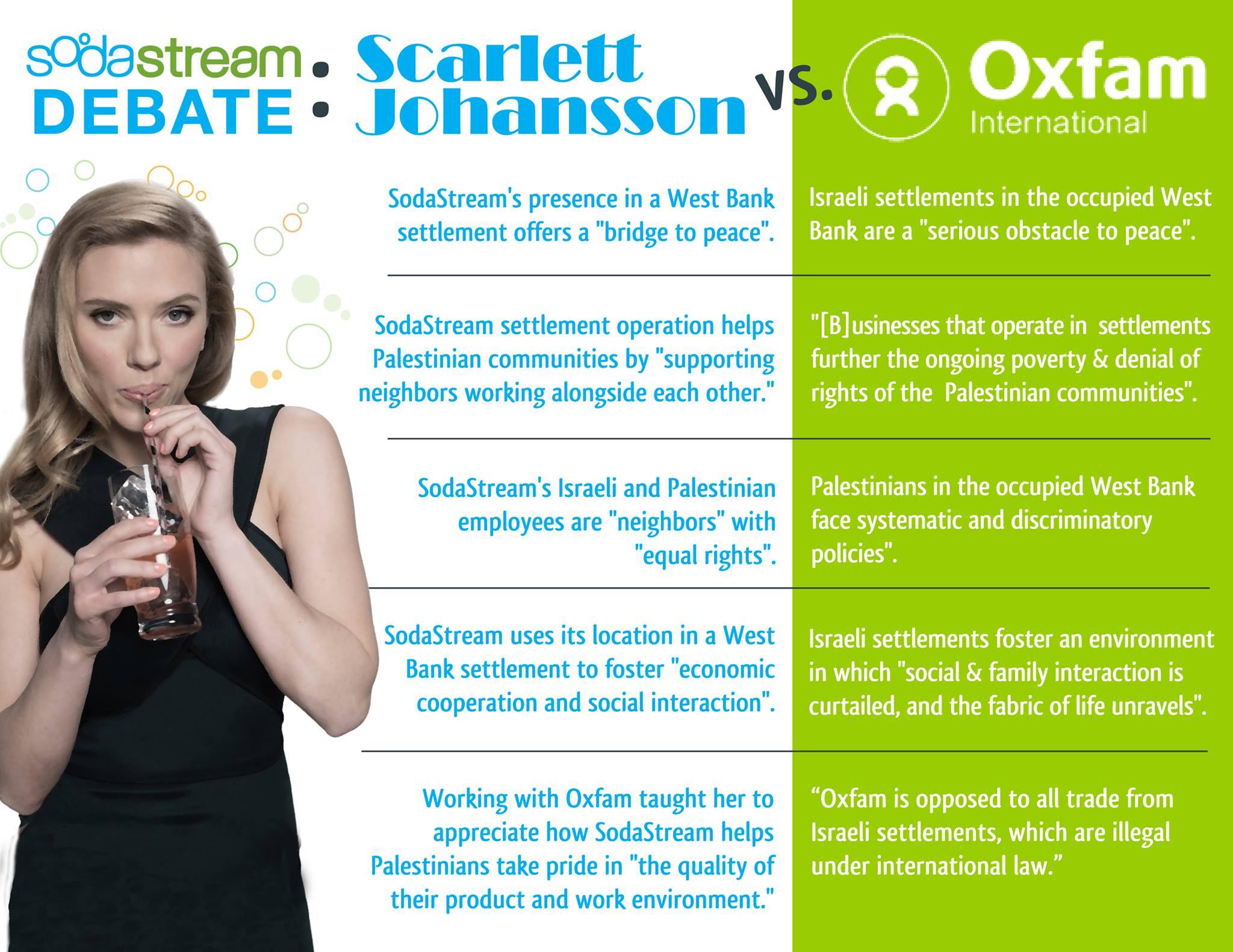
By now you have likely heard about the controversy over Hollywood star Scarlett Johannson and her love triangle between SodaStream, a company that manufactures products in an Israeli settlement and Oxfam, an international NGO that opposes settlements. The contradiction is obvious and for anyone still unclear, this info-graphic is helpful.

But one of the most pernicious responses in this debate from the anti-BDS crowd has been to claim that such a boycott would hurt Palestinian workers employed at SodaStream's factory in the illegal Israeli colony of Mishor Adumim. The long and dark history of colonialism is littered with this sort of thing. Some Europeans justified the treatment of Native Americans because they were "civilizing" them. We witnessed similar arguments in more recent periods of colonialism in Africa, for example. The notion that systems of oppression can be justified because of the limited and perceived gains that they may afford to a few while dispossessing them and most of their kin in a variety of other ways is not new.

Yes, a Palestinian working in a settlement may not otherwise have a job. Unemployment in the West Bank is above 20%. That the settlements and the system they are part of reinforce the economic realities that force Palestinians into choosing working within the very system that oppresses them.

Many Palestinians are confronted with the choice of seeking livelihood within this system or having no livelihood to speak of. This is a reflection of the captive labor market dynamics of the occupation. Palestinians should have the choice to work for and within their own independent economy but they don't. That is the problem here and it is a problem that is created, enforced and supported by Israeli settlements.

Yes, a small number of Palestinians may derive their livelihood from work on a settlement, but a much more significant number is suffering because of these settlements. To use the former to justify the later is absurd and yet it is precisely what Sodastream and the anti-BDS chorus has done in this case.

How do Israeli settlements impact the Palestinian Economy? The list is long and devastating but here are a few of the ways.

Land Confiscation - "Since the beginning of the occupation", notes this Btselem report, "Israel has taken control of hundreds of thousands of dunam [four dunam = 1 acre] throughout the West Bank, with the primary objective of establishing settlements and providing reserves of land for their expansion. It has done this by means of a complex legal-bureaucratic mechanism whose central element is the declaration and registration of land as "state land." In addition, Israel uses three complementary methods to seize control of land: requisition for military needs, declaration of land as abandoned property and the expropriation of land for public needs. In addition, Israel has also helped its Jewish citizens to purchase land on the free market for the purpose of establishing new settlements.67 Using these methods, Israel has seized control of some fi fty percent of the West Bank, excluding East Jerusalem" 
Restriction on Movement - "The establishment of Israeli settler-only roads and military zones" says Oxfam in this report on the Jordan Valley,  "means that many Palestinian farmers throughout the Jordan Valley are not able to access their farms. Tractors and other equipment are often confiscated, while herders are prevented from grazing their animals, which are often impounded for straying into a military zone. Palestinian herders must also buy wheat or barley to feed their herds, because they do not have access to their pastures.76 These significant additional costs incurred due to restrictions on access and movement are stifling production and driving many Palestinian households further into poverty. 
Restriction on Access- This World Bank report talks about the impact of Area C of the West Bank which is where all the settlements are located and is off limits to Palestinians: "Area C constitutes 61 percent of the West Bank and is the only contiguous land connecting 227 smaller separate and heavily residential areas. The 1993 Oslo Peace Accords stipulated that Area C be gradually transferred to the Palestinian Authority (PA) by 1998. This transfer has never taken place....With growth of approximately six percent annually needed to absorb new entrants to the labor market, let alone making a dent in the soaring rate of youth unemployment, urgent attention is needed to find ways to grow the economy and create jobs. A vital economy is essential for citizen well-being, social stability and building confidence to underpin the challenging political negotiations. However, the Palestinian economy, which currently relies on donor financed consumption and suffers from ongoing stagnation of the private sector, is unsustainable. The report estimates that if businesses and farms were permitted to develop in Area C, this would add as much as 35 percent to the Palestinian GDP. Freeing economic activity in Area C would have a particularly high impact on the development of businesses in agriculture and Dead Sea minerals exploitation, stone mining and quarrying, construction, tourism, and telecommunications. Other sectors would be able to benefit from improvements in the quality and cost of infrastructure and increased demand for goods and services. The volume of increased economic activity would greatly improve the PA’s fiscal position. It is estimated that government revenues would increase by US$800 million, which would cut the fiscal deficit by half, hence reduce the need for donor support, and reduce unemployment and poverty rates." 
Resource Usurpation- "For four decades",  states Amnesty International in this report, "Israeli military orders issued ostensibly to “protect” nature resources and reserves, including water resources, have had a crippling impact on Palestinian agricultural activities throughout the West Bank, while Israeli settlers, during the same period, have been given virtually unlimited access to water supplies to develop and irrigate the large farms which help to support unlawful Israeli settlements." 
Settler Violence - "Settler violence" says this recent UN OCHA special focus case study "has severely undermined the livelihoods of many families in this area, contributing to the relocation of some people in search of better livelihood opportunities elsewhere, including abroad. Those who continue to farm incur financial losses, partly because of difficulties in cultivating their land consistently, and because of the damage to their property or theft of their crops by settlers, in which case they lose both the money invested as well as the potential earnings from selling the crops."

There really is no debate about the impact of settlements on the Palestinian economy. The impact is devastating, in large part because of the reasons listed above. Anyone arguing settlements have had anything but a negative impact on Palestinians and their economy is either misinformed or disingenuous or both. Sodastream is part of this system and this system has done exponentially more to hurt Palestinians than anything else. 
read more...

Feb 24, 2012

Amman Talks: No Deal Abbas' Fault? No, Diehl.

Jackson Diehl, the Jerusalem Washington Post editor who has often written one-sided columns squarely placing blame on the Palestinians or President Obama for the death of the Peace Process is at it again. In a piece today, Diehl posits that the Amman talks failed because......."the Palestinian leader punted". Original stuff from Diehl, I know. He's blamed Abbas and Obama several times, including here, here and here, in the past year and as you can see in the columns, he dosn't bother to quote any Palestinians.

This most recent piece is especially ridiculous. Diehl paints the picture that the Israelis presented a proposal to the Palestinians on borders. What he won't tell you is that the Palestinians presented a detailed written document, with maps, specifying their position on where the border should be, while the Israelis put nothing in writing and presented no maps whatsoever.

Diehl tries to hide the fact that the Israelis refused to reply with a written and detailed document like the one the Palestinians provided. He states in his piece that the Israelis "presented substantive proposals" and that Netanyahu's negotiator "set out" a proposal on borders in the final meeting. "Presented" and "set out" are Diehl's ways of dancing around the reality that the Israelis refused to put anything in writing.

What is even worse is that Diehl relies on a report from Haaretz' Barak Ravid which he clearly selectively reads. In Ravid's report, it becomes evident that the Israelis never submitted a written proposal or a map but rather presented "principles". (Maps, by the way, tend to be helpful when discussing things like borders.) Anyone familiar with the negotiations who read Ravid's article could hardly describe the principles laid out by Molho as anything other than vague and unhelpful.

The Annapolis talks which ended in 2008 suffered from a similar flaw when, at the highest levels, the Israeli Prime Minister Ehud Olmert at the time simply flashed a map before President Abbas without allowing him to keep it for analysis or discussion. We learn from the Palestine Papers that the discussion on borders fell apart over issues like the settlements of Ariel and Maale Adumim, two large settlements deep in Palestinian territory. When talking about land swaps of 1.9%, or 4% or 6.8% or 10.2% the specifics tend to matter.

So when the Palestinians presented a detailed document showing where they believed the line should be, they did so with the faith that their Israeli counterparts would respond with the same level of seriousness about the specifics. To understand just how vague and unhelpful the Israeli proposal was, let's go back to Ravid's report, the same one Diehl quotes (emphasis mine):

Molho presented several principles:

1. The border will be drawn in a way that will include the maximum amount of Israelis living in the West Bank, and the minimum amount of Palestinians.

2. Israel will annex the large settlement blocs, without defining what exactly is considered a ‘bloc,’ nor defining its size.

3. It is necessary to first solve the problem of borders and security in relation to Judea and Samaria, and only afterwards move to discuss the topic of Jerusalem which is far more complicated.

4. Israel will maintain a presence in the Jordan Valley for a period of time. Molho did not mention how long nor what kind of presence.
So, if you are the Palestinian side and you painstakingly drew a specific line through what is your own territory, to include in a written proposal to the Israelis about where the border should be, how would you interpret the proposal from the Israeli side as characterized by Ravid above? The Israelis want to keep most of the settlers in most of the blocs but wont say what a bloc is or how big it can be. They want to keep a presence in the Jordan valley but wont say for how long or what kind.

What kind of nonsense is this?

When the disagreements between the sides comes down to specific settlements and fractions of percents, precision is necessary for progress. What the Palestinians got in return for their good faith effort in presenting a precise map was vague principles that indicated the Israelis were not interested in moving forward or matching the seriousness of their counterparts.

Despite facing tremendous pressure from his own public NOT to return to what has amounted to worthless negotiations for decades, Mahmoud Abbas agreed to the Quartet call for a three-month timeline for negotiations on security and borders. The Israelis supposedly "agreed to put forward a comprehensive proposal on borders within three months." The Palestinians, for their part, actually submitted a "document relating to security arrangements and the prospective borders of a Palestinian State, in which they agreed to a 1.9% land swap of West Bank territory"

The Israelis submitted NOTHING in writing and then, on the final day of the end of the three months since the Quartet call, Netanyahu's representative provides nothing more than vague principles.

Any half-objective observer must conclude that the Israelis are simply wasting everyone's time.

Here is what Diehl concluded:
Yet Abbas passed up what could have been an opportunity to press Netanyahu for his bottom lines on the terms for statehood — and force a debate in Israel. Not for the first time, the Palestinian leader punted.
You'd think Diehl would at least chide the Israelis for waiting until the very last day to present these undetailed principles just as he chided the Palestinians for waiting until the 9th month of a 10 month 'settlement freeze' as he did in this column. Of course, if you thought that, it would be because you thought of him as some sort of consistent and objective observer and not a hack. And, of course, you'd be wrong.

Diehl has effectively acted as Netanyahu's finger in Washington - ready to point blame on the Palestinians and Obama in a effort to set the discourse in favor of an Israeli Prime Minister, who leads the most right-wing coalition in Israeli history and is dedicated to continued colonization of Palestinian territory.

Thankfully we have this thing called the internet and can expose all the additional fingers pointing right back at Jackson Diehl.
read more...

May 26, 2011

The @NYTimes: More Zionist than the Zionists

To welcome the triumphant Benjamin Netanyahu - conquerer of Capitol Hill and tamer of American congressmen - back to Israel, a new Israeli colony was inaugurated beyond the Green Line in occupied Palestinian territory. With the announcements of settlement activity preceding and following his trip, the Israeli government places a big exclamation mark at the end of each rejectionist sentence uttered by Netanyahu during his address to the US Congress.

The new building was covered by both Israeli and American media. Can you guess which lede kicked off the article in the American publication and which led the Israel publication? (emphasis mine)
Lede 1.

One day after Prime Minister Benjamin Netanyahu declared that Jerusalem will not be divided, the speaker of the Knesset and several other government ministers attended a dedication ceremony for the new Jewish settlement of Ma'aleh Zeitim, in East Jerusalem's Ras al-Amud neighborhood.

Lede 2.

Senior Israeli government officials and dignitaries on Wednesday attended the dedication ceremony of a Jewish apartment complex in a hotly contested, predominantly Palestinian neighborhood of the city across the 1967 boundary.

The first lede, which refers to the building as a "settlement" after mentioning a relevant rejectionist point made by Prime Minister Netanyahu, is in fact from the Israeli newspaper. The second lede, which shamefully misinforms its readers by calling the building "apartments" is from our very own New York Times. I went into detail here about how the New York Times has lost it's way when it comes to the historical narrative surrounding the Nakba and how it has adopted the Zionist telling of the story.

But it seems the inability to be impartial and shake the Zionist narrative transcends discussions of history and is prevalent in the New York Times in its reporting of events ongoing today. I argue that calling the part of Jerusalem where these new structures are being built "East Jerusalem" is inaccurate and a de facto adoption of the Zionist narrative. This is based on the fact that Israel unilaterally annexed an additional 70 sq. km of occupied Palestinian territory and called it "East Jerusalem". Don't get me wrong, I don't think calling them settlements, as Haaretz does, is really accurate either (I think "colonies" is the most appropriate term). But the New York Times takes the whitewashing of occupation to a whole new level by using the language they chose.

It is even more baffling because the very same New York Times article that begins by characterizing the building as a harmless "apartment complex" goes on to say this (again, emphasis mine):
Israel conquered the eastern, Arab part of Jerusalem from Jordan in the 1967 war and annexed it in a move that has never gained international recognition.
So the question that remains is this, if the annexation of the territory around Jerusalem occupied in 1967 is not recognized internationally (including by the United States) why does the New York Times recognize it when it is supposed to be an unbiased source of information? Or, perhaps more to the point, when put in contrast with the description of the same events by an Israeli publication, why is the New York Times more zionist than the zionists?


read more...

May 23, 2011

Obama to Palestinians: Eh, Colonization Happens

While the focus of reactions to President Obama's speech last week and Sunday at the AIPAC conference have been about his reference to the long understood principle of the 1949 armistice line (i.e. 1967 lines or the Green Line) most have missed a very dangerous message Obama and Netanyahu have sent to the Palestinians that is yet another reason why American-led negotiations are bound to fail.


Obama explained on Sunday what Netanyahu and right-wingers in the US and Israel pretended to misunderstand. He never said Israel had to retreat to the Green line, he said that that would be the baseline for agreed upon swaps. This is of course nothing new as both Obama himself and his press secretary have been making clear since the speech on Thursday. I discuss how negotiators were using this principle before Obama was President and also how the US delegation to the talks sought to impose Israeli demands on the Palestinians when the swaps were not agreed upon.

But the message to Palestinians was sent not only through what Obama said but also what he didn't say. The speech marked a clear departure from the earlier attempts at a settlement freeze, a first-phase Israeli obligation under the Road Map which both parties accepted in 2003. Sure, it had been clear that Obama backed away from the settlement freeze initiative before this, but this coupled with the way he and Netanyahu described the Israeli settlements in the past few days indicates to Palestinians that there is no deterrence for further Israeli colonization of their land and no reason for the Israelis not to constantly re-leverage their bargaining position by continuously expanding these colonies.

In his address on Thursday, President Obama mentioned Israeli settlements once, and certainly did not directly condemn them. He merely said that "expectations have gone unmet" but who is at fault for this? Is it the George Mitchell camp for expecting too much of the Israelis (abiding by their obligations) or is it the Israelis for consistently violating those obligations? Obama doesn't say, but the newly resigned George Mitchell, listening to the speech in the audience at the State Department during his last week on the job likely has no doubt about what was intended.

The ambiguous language here is deliberate so as to avoid addressing a delicate issue which put the Obama administration in hot water with the Israel lobby previously. Unfortunately, this is precisely where Palestinians needed clarity and the obfuscation suggests to them instead that American domestic politics are still hog-tying this President.

Just look at how Netanyahu referred to the settlements in his remarks with President Obama after they met in the White House on Friday (emphasis mine):
the 1967 lines ... don’t take into account certain changes that have taken place on the ground, demographic changes that have taken place over the last 44 years.
Even Netanyahu, who never has trouble communicating in English, floundered and paused in search for a euphemism vague enough to circumvent any mention of Israel's colonization.

Then, like clockwork, Obama reiterates practically the very same language in his address to the AIPAC conference two days later:
That’s what mutually agreed-upon swaps means. It is a well-known formula to all who have worked on this issue for a generation. It allows the parties themselves to account for the changes that have taken place over the last 44 years. It allows the parties themselves to take account of those changes, including the new demographic realities on the ground, and the needs of both sides.
It is hard to tell what is most disturbing about this. There is of course the near vomit-inducing reality that an American President is repeating the narrative of a foreign Prime Minister before a room full of lobbyists who are lobbying for that very Prime Minister's interests. Then there is the narrative itself. To reduce the conscious and calculated process of colonization in the occupied Palestinian territory, illegal under international law, to the equivalent of moss growing on a tree for a few decades is not only ludicrous and offensive but it is the whitewashing of a crime which Palestinians have been the direct victims of.

500,000 Israelis did not fall to sleep in on one side of the Green Line in places like Tel Aviv only to wake up on the other side in places Kiryat Arba, Ariel, Har Homa and Pisgat Ze'ev. Colonization is not a passive natural process that happens over time, as described by the Israeli Prime Minister before being repeated by the American President. It is a violent and state-driven process which involves breaking international law, dispossessing land owners through the use of force and monopolizing the natural resources of another people.

The failure to condemn the process by which these demographic changes "have taken place", while asking Palestinians to simply accept this new reality, is tantamount to supporting the continued colonization of Palestinian territory. In short, the President of the United States, which is trying to convince Palestinians his country can be an even-handed mediator, is saying Israel will not be held accountable for violations of international law and obligations of the peace process by us, you Palestinians will just have to deal with it.

And this is supposed to lure Palestinians back into American-led negotiations?


read more...

Apr 20, 2011

Israeli Settlers Make My Point


Yesterday we presented an analysis of data covering several years worth of Israeli settler violence and approximately 3,000 instances of attacks. We presented numbers, graphs, pictures and video of attacks that were both statistically and analytically solid. Yet, despite the fact that this research took months and that it will continue to serve as an important resource on this issue, Israeli settlers yesterday made my point in only a few hours.

You see, by the time I was done with the presentation, which can be seen in its entirety below, I came back to my desk only to find an e-mail about how Israeli settlers attacked school children in the village of Tuwani in the Hebron governorate. I spoke specifically about the perils facing this particular Palestinian village at 25 minutes in. So it came as no surprise to me that Palestinian school children had rocks thrown at them by Israeli settler children as the settler parents watched. This is a regular occurrence for the school children of Tuwani, so much so in fact, that special escorts have to be arranged to take them to and from school out of fear of settler attacks.

One of the main points of the presentation was that settler violence happens all the time even though we might not hear about it. You might think that the instance of settler violence in Tuwani on the same day as this presentation is enough to prove that point, but in case there was any doubt, colonists in the north of the West Bank had other things on their mind.

That's right, yet another settler attack took place against the Palestinian village of Burin, right around the time we were making this presentation. At about 28 minutes in I discuss the village of Burin and why it falls prey to more settler violence than any other Palestinian village. It is located in between two of the most violent colonies in the West Bank, Yitzhar and Bracha.


Settler violence, contrary to what many may believe, is not retaliatory nor is it simply a response to Israeli government actions against outposts which have been called "price tag" events. It is a symptom of occupation. The stratification of security jurisdiction created by the Oslo accords allows settlers to have free reign over Palestinian populations living in Areas B and C. We see upwards of 90% of all settler violence incidents occuring in these areas precisely because there is no law enforcement deterrent to acts of violence against Palestinian civilians. As you can see from the chart above, settler violence is dramatically on the rise over the past few years. In 2006 the average number of settler violence events per month was about 20; in 2010 it nearly tripled, with just over 57 per month.

Our event yesterday was an attempt to sound the alarm on a violent phenomenon which is targeting Palestinian civilians and their property more and more each year. The violent settlers which attacked Palestinians in Burin and Tuwani yesterday only help make this point.


read more...

Apr 14, 2011

You Have The Right To Remain Occupied

Last week a number of white students were found dead in a dorm room at Columbia University in New York. The police arrived on the scene and the mayor soon declared that he would stop at nothing to find the black murderer. Shortly thereafter, the army was called in and the neighboring Harlem neighborhood, where it was claimed the alleged perpetrator must have came from or fled to, was encircled and besieged. Raids were conducted in each apartment and home, dwellings were ransacked and property destroyed. Hundreds of blacks were detained, many were DNA tested and finger printed. This continued for a month, day in and day out, but no charges were made against any suspects.

If you haven't already guessed, this is a fictional story. Such things should never occur in a functioning democracy with rule of law, civil rights and due process. But something very similar is happening to a Palestinian village called Awarta at the hands of a state that claims to be "the only democracy in the Middle East."

Nearly a month ago, a family of 5 Israeli colonists living in Itamar were found murdered in their home. The gruesome attack was immediately blamed on a Palestinian, and the nearby village of Awarta fell under the cross-hairs. The Israeli government has yet to put forward one shred of evidence that would suggest anything about the identity of the murderer. We are simply supposed to rely on the good intentions of the Israeli government. (Map right shows Itamar and Awarta)

The entire investigation has been under a gag order. This is very, very strange. Ever under the international microscope for their actions against Palestinians in Occupied Territory, the Israeli government has always put forward aggressive PR campaigns in an attempt to justify their actions and vilify Palestinians and their sympathizers. One easily recalls the tapes and images so rapidly distributed after Israeli commandos boarded a Gaza-bound civilian aid ship in international waters last year killing nine civilians. For a state whose government has suffered one PR disaster after the other, you'd think that if there was any evidence showing the murderer was Palestinian, Israeli Prime Minister Benjamin Netanyahu would be screaming about it atop the tallest building in Tel Aviv.

Yet, nothing but complete silence. Silence, of course, except for the Palestinians in the village of Awarta. Constant Israeli raids round up Palestinian civilians in what can only be understood as arbitrary arrests. The terrorizing of an entire village, held hostage to Israeli whims, is collective punishment and a regular feature of occupation.

This is occupation. A people are treated fundamentally differently and stripped of their rights because of their ethnicity. Yet while the media in the land of the free and home of the brave certainly covered the murder of the Israeli settlers, quite poorly I might add, where is the news story about how Israel's massive arrest campaigns run contrary to American values? Where is the news story about arbitrary and forced DNA testing? Where is the story about how groups of people are arrested in the middle of the night, taken from their ransacked homes and then probably tortured and at the least intimidated to provide information implicating others in the village?

Murderers can be of any religion, nationality or ethnicity. But democracies are judged, at least in part, on their respect for civil rights and the rule of law. Israel's collective punishment of occupied Palestinians in Awarta are but another clear indication of where it fails the democracy test.

Today, there was news that a Palestinian teen was found dead in Al-Khadr. This Palestinian locality outside of Bethlehem has frequently been attacked by settlers. More often than not, the settlement of origin of settlers who attack Al-Khadr is near by Neve Daniel. In recent years there have been instances of destruction of property, assault, theft and arson perpetrated by settlers from Neve Daniel against Al-Khadr (much more on settler violence here). If this became a murder investigation, would the Israelis stand for the encirclement and collective punishment of their colony Neve Daniel? Would Israelis stand silent as every Jew in the colony was arrested by the IDF, DNA tested, and possibly coerced into testimony without ever being charged?

Of course not. But we will never have to worry about how Israelis would react to such a predicament, since the IDF would never apply the same inhumane treatment and roundups to Israeli settlers, whose mere presence in the West Bank is illegal, as they do to the native Palestinians whom they have completely stripped of their rights. Most of the time, Israeli settler violence goes unpunished while Palestinians are punished whether they attack or not. That is what occupation is all about.


read more...

Mar 24, 2011

Happy Birthday Deya, Rest In Peace

Dear Deya,

Facebook alerted me that today was your birthday. Happy Birthday. I had always wondered what happened to people's Facebook pages after their owners die. Yours stands as a testament to your all-too-short life and the amazing number of people you touched who are all wishing you happy birthday on your wall today - a year after you died.

Do you remember when we met? I do. It was at a Palestinian heritage event in New Jersey. The lovely host family you were staying with brought you to meet the Palestinian community in the area. That's when I learned about your situation and the Israeli settler's bullet that ripped through your 14 year-old body. I remember that night vividly, there were speakers and music and traditional Palestinian line dancing, or dabke. I remember the hesitation I felt joining the dabke line that night when I saw you across the room. You sat in your wheel chair looking at the dance floor just wishing you could walk again one day. It was impossible for me to dabke seeing this and I remember telling you that night that one day you would get better and join the dabke line again. We became good friends.

You did eventually get better, before you got worse. American doctors performed the numerous
surgeries you wouldn't be able to get in Palestine. Despite the settler's bullet which fractured inside you, partially tearing through your organs and lodging in your spine, the doctors performed miracles and you slowly made progress. The dream of joining the dabke line seemed like it may come true. Eventually, you were able to walk with a limp and as more time passed you slowly regained your stride. But little did we know about the toll all of this took on the organs inside your body. (Image right: Newspaper photo of Deya in one of the first of his many stays in a hospital)

You went back to Palestine and back to high school where you began what we thought would be a promising future despite the years of schooling you missed. You were in love with poetry - I recall you reciting it in classical Arabic as a teenager in the hospital's visitor's room. You loved to sing George Wassouf songs, learned to play the oud, and became an aspiring artist. Eventually you graduated and the teenage boy whose hopes had once been shattered by Israeli settler violence became a man with the world before him.

Soon, though, we heard the news. All the operations you went through couldn't prevent that settler's bullet from sealing your fate. We learned of your liver failing again and your speedy departure to Europe where you may have an opportunity for more surgery or even a transplant. But it was too much for your liver to handle. The last thing we heard was that your blood, unable to be filtered by your failing liver, contained 500 times more toxins than normal and was poisoning your body.

You died soon after, about a month before your 23rd birthday. We never got to dabke together.

They gave you a martyr's funeral in Palestine, even though you were not shot taking part in the resistance. You were merely born Palestinian and walking back from school that day. Which, I suppose, is form of resistance itself. (Image right: Deya, about a year before he died)

Your life, perhaps symbolizing the Palestinian struggle, was a roller coaster of hope and despair, ultimately ending in tragedy.

What happened to you opened my eyes though. As Palestinians, we had always heard and talked about the checkpoints and the wall, the Israeli soldiers, their incursions and bombings, but we rarely ever exposed the issue that took your life; Israeli settler violence. We always had maps to talk about other things, we needed statistics to talk about settler violence.

In your memory, and in dedication to all Palestinian victims of Israeli settler violence, we embarked on a comprehensive study of this on going phenomenon, how it happens, and who it effects. This is meant to shed light on a facet of occupation that occurs on a daily basis but is rarely, if ever, discussed and gives us a basis upon which to have a discussion about it.

In our database, we record victims of settler violence as either injured or dead. For the 9 years after you were shot you would've been classified as the former, but not anymore. I can only wonder how many of the 1,064 Palestinian civilians classified as injured over the past 7 years in our database today will one day meet the same fate as you. (Image right: photo of the martyrdom poster for Deya in Palestine.

We'll be presenting the comprehensive analysis on April 19th, 2011. The least we can do for victims of settler violence is teach people about this problem in the hopes that they will join us in working to end it. I hope you will be watching, from somewhere.

Happy Birthday Deya and Rest in Peace,

Yousef
read more...

Mar 22, 2011

Israeli Settler Violence: Not Even the Animals Are Safe

Does PETA have an international division? After reading this post in Mondoweiss this morning, I figured I'd add some context and numbers to the poignant images which captured events all too common and far too underdisscussed.

By now, readers of this blog have gotten to understand some of the risks posed to Palestinian civilians because of settler violence. But what many don't really grasp is how often the victims of Israel's fanatic settlers are not only Palestinian people, but Palestinian livestock. Sheep, horses, cows and camels have all fallen prey to settler violence in the past and many of these instances are captured in our settler violence database.


For many Palestinians, farming and shepherding is a way of life. They had been tending to their livestock and crops long before the Israeli occupation began in 1967, long before the state of Israel in 1948 and long before Zionism. But too often, it is precisely these Palestinians which fall prey to violent Israeli settlers. You see, you can't take your sheep to graze in an urban setting of densely populated concrete houses. But for the vast majority of Palestinian's tending to sheep, this means choosing between putting yourself in harms way or abandoning your way of life. Because of the Oslo Accords, most Palestinian urban centers are in what's called Area A, where the Palestinian Authority maintains security control (although Israeli forces can enter Area A at will), but most rural territory is in Area B and C where Israeli forces maintain security control. But Israeli forces see themselves there to provide security for Israelis, i.e. the settlers, and not provide security for Palestinian civilians. It should come as no surprise then that the vast majority of settler violence, upwards of 84%, occurs in Areas B and C. Because these areas stratify security control, settlers basically have free reign in Areas B and C to do as they please. There have been numerous instances where settlers attack Palestinians in Areas B and C, and Israeli forces intervene only to protect the settlers. Preventative action is almost never taken.

So when it comes to settler violence, shepherds and farmers are sitting ducks, and so are their sheep, cows, horses and the occasional camel. Our database did not code specifically for attacks on animals, but we did record injury, killing or mutilation (yes, mutilation) of livestock. Initially, I was hesitant to record such data because I thought some might take the opportunity to trivialize settler violence as Hatfield-McCoy type feuds and miss the critical point that settler violence is the inevitable byproduct of a system of inequality called occupation.

These data points should give you an idea of the inherent risks of being a Palestinian shepherd under occupation:

September 2004 - Settlers run over a herd of sheep near the village of Haris in Salfit killing and injuring 18.

August 2005 - Settlers from Kiryat Arba in Hebron poisoned and killed the horse of a Palestinian civilian living near by.

February 2006 - Settlers from Meitzad in Hebron district sprayed poison over land where Palestinian shepherds bring their sheep leading 40 of them to die.

April 2006 - Settlers from an outpost in the Ramallah district opened fire towards civilians in the village of Al Mughayyir and killed a horse.

May 2006 - Settlers opened fire at a herd of camels belonging to a Palestinian civilian near the village of Al-Awja in the Jericho district killing one camel and injuring another.

November 2007 - Settlers in a car ram through a flock of sheep killing 15 in the Jericho district.

July 2008- Settlers sprayed poison in grazing grounds which killed 14 sheep and made 18 others sick.

January 2011- Settlers opened fire at a flock of sheep near Tuwani in Hebron killing the sheep dog as well as one of the sheep.


I could go on and on, but I think you get the point. As a Palestinian heading out to tend to your sheep or pick your olive trees, you venture into the unknown and may very well be subject to Israeli settler violence. The frequency and location of these events, which will be discussed in detail here, rule out any possibility that these are isolated incidents. There are countless more cases where Palestinians have had their animals targeted. In some instances the Palestinians tending to the animals were killed or injured as well, like 15 year-old Sharif Ishtiyeh from Salem village who was mowed down and killed by an Israeli settler from the settlement of Elon Moreh, deep in the West Bank.

Settler violence, in its many forms, is an outgrowth of the Israeli occupation and a systematic attack on many facets of Palestinian life, even some of the most simple and ancient.


read more...

Mar 21, 2011

Hebron: Ground Zero for Israeli Settler Violence

It's Monday and, like most days ending in the letter "y," this means there have been acts of settler violence against Palestinian civilians or their property in the West Bank. To state that these events happen on a daily basis is no exaggeration. In fact, a query of our settler violence database reveals that there were 629 events last year alone (an average of 1.7 attacks per day).

Today was no exception to the rule. Maan News Agency reported that "A 32-year-old from the south Hebron hills told Ma'an he was stabbed in the chest on Monday by settlers from the Ma'on settlement." Within minutes another story came over the wire; this one reporting that "Two Palestinians were shot Monday afternoon when a settler disembarked from his car on the Jerusalem-Hebron road and opened fire on a funeral procession heading to the Beit Ummar cemetery."

Both of these attacks today took place in the governorate of Hebron in the West Bank. This district is the epicenter of Israeli settler violence and usually accounts for more settler attacks than any of the West Bank's 9 other districts. In our database, out of the approximately 3,000 settler violence events recorded, Hebron has been the locale of 31% of the events. While trends in the past couple years have indicated a shift to the north, with more and more settler violence occurring in and around Nablus and Qalqilya, Hebron continues to see more than its share of settler violence when compared to other districts. Interestingly, the settler population in Hebron is relatively low compared to other districts. So a relatively small number of settlers account for the single highest number of attacks in any governorate. One reason for this is the unique location of certain settlements in Hebron, which include a settler population right in the heart of the Old City of Hebron that is responsible for regular violence against the Palestinian population there. Our database indicates that in the Old City of Hebron alone over the past 6 years, there have been 451 different acts of settler violence which include over 165 instances of stone throwing, over 116 physical attacks and assaults, over 30 instances of arson, over 45 instances of destruction of property, and 15 vehicular attacks which resulted in the injuring of 218 people.

But that's just in the city of Hebron. An almost equal amount of settler violence events (460) occurred inside of the governorate, but outside of the city, like the two attacks that took place today where settlers attacked Palestinians in Beit Ummar in the north of the governorate and in the Yatta area in the south. Attacks on these areas are not rare. The single village of Beit Ummar has seen at least 21 attacks in the period covered by our data, resulting in 11 injuries and one death, mostly from vehicular attacks. The area south of Yatta faces a barrage of attacks from two particularly active settlements in settler violence: Sussia and Ma'on. Combined, settlers originating from these two settlements accounted for 77 attacks, resulting in the injury of 72 civilians and inestimable damage to property.

In the north of the district, like today's attack in Beit Ummar, settlers tend to take advantage of the roads and utilize shoot-and-run tactics, or simply run over civilians with their vehicles. In the city of Hebron, attacks are far more inter-personal because of the proximity between settlers and Palestinian civilians. This is why stone throwing and beatings are so common. Often, these attacks happen under the watch of Israeli soldiers in the city. Attacks in the south, like today's attack south of Yatta, tend focus on isolated areas or villages, and targets are often schools, children or shepherds and their sheep grazing in rural areas.

While settler violence is present in all corners of the West Bank, today's attacks highlight the particular and unique challenge faced by Palestinian civilians in the district of Hebron, which face a disproportionate number of attacks from Israeli settlers on a consistent basis.

For a complete analysis of our settler violence data, check out our upcoming event on settler violence on April 19th. You can attend in person here at the Palestine Center in Washington or watch the live webcast.
read more...

Mar 14, 2011

Legality vs. Legitimacy: America's Ambiguous Umbrella Protecting Israeli Settlements

The response by the Netanyahu government to the gruesome murder of 5 settlers in the settlement of Itamar was typical; they announced they'd build even more settlements. The American response to the Israeli announcement was perhaps even more typical. This story summarizes what has become a near-automated and ambiguous response(emphasis in this and all excerpts is mine):
In the first U.S. reaction to the Israeli decision, the State Department said in a statement Sunday that Washington was deeply concerned by continuing Israeli actions with respect to settlements in the West Bank."

"Continued Israeli settlements are illegitimate and run counter to efforts to resume direct negotiations," the statement said, adding that "through good faith direct negotiations, the parties should mutually agree on an outcome that realizes the aspirations of both parties."
If anyone else is wondering what this means, you are not alone. The terminology of "legitimacy' entered the discourse of official US policy after President Obama delivered his speech to the Muslim world in Cairo. At the time, President Obama said "The United States does not accept the legitimacy of continued Israeli settlements." This line was greeted by applause from the crowd in the auditorium where he was speaking, as well as from onlookers around the Arab and Muslim world. Many welcomed the fact that the new American President was directly criticizing Israel's settlement enterprise. The reaction to this line came because he said it, but not necessarily because the meaning and gravity of the language used was fully appreciated and fully understood.

What does it mean for the US to consider settlements "illegitimate"? And more importantly, how does this concept of legitimacy differ from the more important concept of legality. After delivering that crowd-pleasing line in Cairo, the President followed it up with language that may offer insight into what is really meant by "legitimacy":
This construction violates previous agreements and undermines efforts to achieve peace. It is time for these settlements to stop.
Note that the President deliberately chose not to say that the construction violates international law. So from what the President said, it seems that to the United States, settlement construction is illegitimate in so far as it violates agreements (not laws) and undermines (American led) peace efforts. By speaking about settlements in this context and completely sidestepping the context of legality, an open question arises about US policy on settlements: Does the United States consider the building of Israeli settlements in occupied Palestinian territory illegal under international law? And if so, why is it so hard to just say it?

An recent episode at the UN Security Council may shed light on an ambiguous US policy. The Palestinians sought to bring a draft resolution to the UN Security Council condemning illegal Israeli settlements. The resolution included the following language:
Reaffirming the applicability of the Geneva Convention relative to the Protection of Civilian Persons in Time of War, of 12 August 1949, to the Palestinian Territory, including East Jerusalem, and the other Arab territories occupied since 1967,

Reaffirming that all Israeli settlement activities in the Occupied Palestinian Territory, including East Jerusalem, are illegal and constitute a major obstacle to the achievement of peace on the basis of the two-State solution,

Condemning the continuation of settlement activities by Israel, the occupying Power, in the Occupied Palestinian Territory, including East Jerusalem, and of all other measures aimed at altering the demographic composition, character and status of the Territory, in violation of international humanitarian law and relevant resolutions,

The United States wanted to avoid a UNSC vote on this issue but when the Palestinians continued to push for the resolution to come up for a vote, the Obama Administration would be forced to lift the veil on the sneaky language they introduced in Cairo and had been using ever since. In a effort to avoid a vote, the US informed Arab governments that it would support a UNSC Presidential Statement (which doesn't carry the weight of a UNSC Resolution) that used language Washington was more comfortable with. It stated:
The Security Council reiterates its previous resolutions and the obligations under the Quarter Roadmap, endorsed by its resolution 1515 (2003), expresses its strong opposition to any unilateral actions by any party, which cannot prejudge the outcome of negotiations and will not be recognized by the international community, and reaffirms that it does not accept the legitimacy of continued Israeli settlement activity, which is a serious obstacle to the peace process.
No mention of legality, which made the statement useless to those supporting the resolution. Ultimately, the US ambassador to the United Nations, Susan Rice, was instructed to veto the resolution and she did. Of the 15 members of the UN Security Council, 14 voted for the resolution and 1, the United States, voted against. In her statement after the vote, Ambassador Rice attempted to explain the reasoning behind the American veto she had just cast. In doing so, she said this in her statement:
Our opposition to the resolution before this Council today should therefore not be misunderstood to mean we support settlement activity. On the contrary, we reject in the strongest terms the legitimacy of continued Israeli settlement activity.
So we know now, perhaps, what wasn't clear in Cairo when President Obama introduced this statement of policy. In Washington's lexicon, legitimacy and legality seem completely unrelated and do not overlap. Some maybe wondering whether or not this matters or if this is just a question of semantics . It matters greatly, of course, because there are clear consequences and actions which must be taken against violators of international law. By insisting on "opposing" Israeli settlements by calling them "illegitimate", the United States simply protects Israel and its settlement enterprise by shielding them from legal obligations. Not surprisingly, Israel has continued with settlement expansion under an American umbrella of intentional ambiguity.

The entire world (except for the Obama Administration and Israel) including anyone with a basic understanding of International Law can state unequivocally that the building of Israeli settlements in occupied Palestinian territory is 100% illegal.

In the past, I wrote about Matthew Lee, an AP reporter covering the State Department who did a fantastic job posing straightforward questions consistently until he got an answer (or lack of one) about the detention of the non-violent Palestinian activist Abdallah Abu Rahmah.

Incidentally, Abu Rahmah was released today after serving 16-months in prison. Maybe it's time for State Department reporters to try to get spokesman on the record about the US government's official position on the legality of Israeli settlements - and not take "illegitimate" for an answer.
read more...

Mar 12, 2011

In Palestine, Everything is Relative: The Settler Violence You Won't Hear About

When I heard the horrific news last night that 5 Israeli settlers were murdered in their home in the settlement of Itamar, I knew it would only be a matter of hours before a shoddy piece of journalism describes the murders as the end of a "lull in the violence" or the end of "relative calm" since 4 Israeli settlers were killed in an attack near Hebron last summer. At that time, the Washington Post ran an editorial saying that the attacks then ended "three years of peace" in the region which we posted about.

So I suppose it should come as no surprise that the Washington Post's own Janine Zacharia leads the way this morning by displaying a complete ignorance of the situation she is supposedly covering or an overt pro-Israel bias (or both). Here's Zacharia's story and the critical excerpt:

The Israeli daily Ha'aretz, citing a preliminary investigation, reported that the children killed were ages 11, 3 and a 3-month-old baby. The newspaper also said that another 12-year-old daughter and two of her younger brothers managed to escape.

The attack shattered a relative calm that had prevailed in the West Bank in recent months as Palestinian security forces assert greater control in the territories where they are allowed by Israel to operate and as Israeli and Palestinians forces coordinate security efforts.

Last August, four Jewish settlers were killed in a drive-by shooting in the West Bank.

Zacharia's chronology is likely representative of the broader mainstream media's coverage of these events, sadly. American readers or consumers of mainstream media (MSM) are delivered a simple, straightforward message: Israelis are killed about 6 months apart and in between everything was calm.

The problem is that for Zacharia and much of the MSM "relative calm" means no Israelis were attacked, injured or killed and ignores the ongoing occupation and violence against Palestinians.

In this period of "relative calm", the Israeli Human Rights group B'Tselem recorded at least 41 Palestinians killed by Israeli forces in occupied Palestinian territory. This includes Omar Qawasmeh, the 66 year old Palestinian civilian who was massacred in his bed while he slept by raiding Israeli soldiers and two 20-something Palestinian unarmed civilians shot and killed at the same checkpoint less than a week apart.

That reports can describe the killings of dozens of Palestinians by Israeli soldiers as "relative calm" and finding them completely unremarkable is disgusting in itself. Still, it's only part of the story.

Readers may know that one of our ongoing research projects at the Palestine Center is the recording and analysis of Israeli settler violence against Palestinian civilians. This past fall, we made an extensive presentation of these data that shed light on a facet of occupation almost never discussed. The presentation covered data from Jan of 2009-Aug. 2010 and included over 1000 instances of settler violence. Since then, we've undertaken the coding of a much more significant period of time that would span 6 years and give us the ability to understand more about the history and trajectory of Israeli settler violence. This would be the most comprehensive analysis of settler violence that I am aware of. I was
hoping to make an updated presentation covering this new data in the fall, however given the recent surge in Israeli settler violence we've expedited the project and will make the presentation this spring.

So what instances of settler violence were there in the period of "relative calm" that Zacharia describes? There were, in fact, over 300 instances of settler violence during this period which left over 85 unarmed Palestinians injured, 4 dead, and inestimable property damage (Including thousands of torched or uprooted olive and almond trees). Among these events were over 26 acts of Arson, 59 acts of destruction of property, 32 physical attacks, 20 shootings, 60 acts of stone throwing and 23 instances of theft. There were also 10 instances of vehicular attacks where settlers mowed down Palestinian civilians including a 5-year old and 11 year old in Hebron, an 85-year old in Salfit and this horrifying act caught on video in Jerusalem.

Attacks originated from the settlements of Adora, Ariel, Ateret, Bat Ayin, Beit El, Beitar Elit, Bracha, Dulip, Efrat, Eli, Eli Zehav, Elkana, Elon Moreh, Haggai, Halamish, Harsina, Havat Gilad, Immanuel, Itamar, Kaida, Karmei Tzur, Karmel, Karnei Shomron, Kedumim, Maale Mikhmas, Maon, Maskiyot, Neve Daniel, Rehalim, Revava, Shama, Shuvot Rachel, Shilo, Sussia, Talmon, Kfar Tappuah, Yaki, Yash Adam and Yitzhar. These attacks were directed against 79 different Palestinian villages and cities in every district in the West Bank....and this is only in the past 6 months.

If these 6 months can be described as "relative calm" one really has to wonder just what extent of violence against Palestinian civilians would be considered noteworthy by the mainstream media?

In a world where everything is relative, it seems the mainstream American press has decided that Palestinian lives are relatively worthless compared to Israeli lives. But this is also a world where the mainstream media is losing its grip on the control of storytelling and information that directly contradicts faulty journalism is available at everyone's finger tips.

We'll continue to do our part to bring this information, especially about settler violence, to you and we hope you'll share it with others who'd otherwise be mislead by a relatively worthless mainstream media.


read more...

Nov 16, 2010

On Bribes, Begging, and Lunacy

Nothing quite says "we encourage you to make peace with your neighbors" like a shipment of advanced weaponry.

If you thought the recent move by the United States to offer the Israelis $3 billion more than the $3 billion a year they get anyway in the form of advanced military fighter planes was farcical enough, guess again.


First, if you missed some of the reaction to Obama's offer, Mark Perry hit the nail on the head when he wrote:
The Obama Administration's newest promise to Israel is abject, embarrassing and gutless. Our country -- our president -- is rewarding a foreign leader who openly boasts that America "is something that can easily be moved," who urges a waiting game with the U.S. because he knows that Israel's friends in the Congress will defy a president who opposes him, who tells his cabinet that he will outfox Barack Obama. We are paying Israel to do something that is in their own interests -- and very much not in ours. That's extortion.
Christopher Hitchens, who seemed to resemble a previous version of himself in this piece, also described the situation well.

But this is where it gets loonier. This report from the Canadian Press seems to confirm Hitchens' worst suspicions:

The future of the Mideast peace process could rest in the hands of one very undiplomatic man: an outspoken 90-year-old rabbi who recently sparked an uproar by saying the Palestinian president should "perish from the world."

The ultra-Orthodox Shas Party is expected to hold the swing vote when Cabinet ministers decide on a U.S. proposal to resume Mideast peace talks. The two Shas ministers participating in the decision are waiting for instructions from the party's spiritual leader, Rabbi Ovadia Yosef.

"All decisions go through the rabbi," said Roi Lachmanovitch, a spokesman for the Shas interior minister.

More on Yosef here.

Does anyone else wonder why we care so much about Israeli domestic politics? I find it hard to think of another situation where we cater our foreign policy to the whims of a foreign governing coalition to the extent that we are willing to embarrass ourselves. For example, when the Palestinians elected a government the U.S. did not like, sanctions followed promptly. But the logic is somehow inverted when it comes to Israel. When the Israelis elect a government the U.S. doesn't like, well, then we reward them with everything we've got.

I know some are trying to make sense out of the Obama administration's move and are arguing that he has limited options given domestic constraints, but I just don't understand how rewarding Israel's incorrigible behavior could be a good thing.

It seems like we are in for several months, if not years, of more failed policy toward this conflict, and Congress certainly will not be of any help. I recently wrote about how Rep. Ileana Ros-Lehtinen was in the twilight zone, and she isn't the only one. Check out the video of the Congressman below arguing that its the Palestinians who must end their settlement building (Yes, you read that right).


Seriously, after all of this can anyone really claim to have optimism or even cautious (read: naive) optimism about the future of U.S. policy toward the conflict?

I suppose there is one thing to be optimistic about: at least the United States is still a country of opportunities because clearly anyone, regardless of I.Q., can be elected into Congress. Sigh.
read more...

Nov 8, 2010

Don't Call it East Jerusalem II

In an earlier post, I tried to explain why the language we use is important, and why using the terminology "East Jerusalem" to refer to places like Jabal Abu Ghneim, which became the Israeli colony Har Homa in the last 15 years, is extremely problematic and an uncritical acceptance of the Israeli narrative. On the right you can see an image of what Jabal Abu Ghneim looked like in 1997, during the Oslo Peace Process, and how it looked in 2005.


Today's announcement of 1300 more units came as Israeli Prime Minister Netanyahu was in the United States. A number of different outlets reported or are reporting on this issue today, and it's important to take note of the language they use. This gives us a fresh and timely opportunity to witness how the media has accepted the Israeli narrative about "East Jerusalem."

Here is AFP's lead:
Israel has approved more than 1,300 new housing units in occupied east Jerusalem, settlement watchdog Peace Now said on Monday, in what a spokeswoman described as "a big provocation."
Reuters:
Israel is pushing ahead with plans to build 1,300 new apartments for Jewish families in Arab East Jerusalem, the Interior Ministry said Monday, despite fierce opposition from Palestinians.
JTA:
A Jerusalem municipal committee has approved the construction of more than 1,000 Jewish homes in eastern Jerusalem.

BBC:
Israel has revealed plans to build nearly 1,300 housing units for Jewish settlers in occupied East Jerusalem.

AP:
The Israeli government is moving ahead with plans to build nearly 1,300 new apartments in disputed east Jerusalem, an official said Monday, a step that could complicate Prime Minister Benjamin Netanyahu's meetings with American officials in the United States.
CNN:
The Israeli government said Monday it is proceeding with plans for about 1,000 new housing units in East Jerusalem, a move that the chief Palestinian negotiator said would derail already suspended peace talks.
NYT:
The construction of Jewish housing in East Jerusalem has been a source of acute tension between Israel and the United States this year. In March, when Mr. Biden was visiting Jerusalem, Israel announced plans for 1,600 Jewish units in another contested area of the city, embarrassing Mr. Biden and infuriating President Obama.
CSM:
Israel has published plans to build about 1,300 new housing units in East Jerusalem neighborhoods, a move that highlights US-Israeli differences just as Prime Minister Benjamin Netanyahu arrived in the United States to huddle with Obama administration officials.

The image to the right shows the location of Har Homa, which Israel, and only Israel, considers part of "East Jerusalem." Click the image to watch a video showing when and where Har Homa and other settlements were built around Jerusalem.
read more...

Nov 1, 2010

A Tale of Two Editorials


On Friday the New York Times published an editorial on the peace process which many noted for its different tone. The piece, titled "Enough Game-Playing", put the onus on Netanyahu and recognized the problem of settlements. Here is an excerpt but please read the whole thing:
We think the burden is on Mr. Netanyahu to get things moving again. The settlements are illegal under international law, and resuming the moratorium, which expired on Sept. 26, will in no way harm Israel’s national interest.
The importance of the New York Times in forming the contours of public policy debates in this country should not be under-emphasized and the recognition that the settlements are indeed illegal is also worth noting because such characterizations, which are factually accurate, are often deemed unfit to print by the Times editorial board.

But how different was this editorial from the past? This piece, from nearly two decades earlier, is also worth reading in its entirety and shows that the tone of the latest NYT piece is not really new.

The context: President George H.W. Bush and his Secretary of State were withholding $10 billion in loan guarantees from Israel because.....you guessed it....Israel's building of settlements.

Here is an excerpt and even though this piece was written almost 20 years ago you can change a few proper nouns and the text is perfectly applicable today:
The showdown is really about the Shamir Government's policy of rapidly and provocatively expanding Jewish settlement in the occupied West Bank, Gaza Strip and Golan Heights. This policy directly compromises both the atmosphere of the conference and the geographic possibilities for trading land for peace.

A succession of U.S. Administrations has opposed Israeli settlements in the occupied territories. And a succession of Israeli Governments has built them anyway. But Mr. Shamir's present Government, the most right-wing in Israeli history, has been particularly zealous on the settlements issue. The Bush Administration believes that Israel violated, at least in spirit, past pledges not to use U.S. loan guarantees to finance settlements. And almost every time Secretary of State James Baker travels to Israel, he has been greeted by a new crop of settlers.
It's amazing how little has changed in the language of the peace process. On the ground, however, a lot has changed. In fact, since the time the first editorial was written to the time the second was printed, the number of illegal settlers living in Israel's colonies in occupied territory have increased from about 240,000 to well over 500,000. Something else has changed. Here is the conclusion to the editorial from 1991:
Using U.S. financial leverage to nudge along a promising peace process amounts neither to duplicity nor anti-Semitism. The President deserves credit, not abuse, for spending his political capital in the cause of Mideast peace.
In 1991, the NYT was supporting a policy of financial leverage over Israel to halt settlement expansion. In 2010, it is suggesting Netanyahu should swallow the bitter pill of excepting an offer from Obama that even the NYT considers "too generous" in return for a temporary and non-comprehensive ban of what the NYT now states is illegal activity.

So is there real progress in the way the NYT or other mainstream American outlets are covering this issue? Not really, and in this case we witness, just as we see with the 'peace process', exponential regression.

One thing that hasn't changed, however, is the ongoing colonization of Palestinian land and the failure of the United States to do anything about it.
read more...

Oct 27, 2010

Ovadai Yosef Award Nominee

In Sullivanesque fashion, were inaugurating the Ovadai Yosef Award for overt racism toward Arabs in historic Palestine. Yosef, of course is the controversial Rabbi and Shas spiritual leader, who has rarely missed an opportunity to talk about how inferior and worthless Arabs and Palestinians are. To call out such instances of racism in this context we'll be posting comments or quotes that are inline with what Yosef typically spews. Our first nominee: MK David Rotem.

A little background: Haaretz reports today that a Knesset panel approved a controversial bill which would allow towns in Israel to deny residency to people who are not suitable to the "community's fundamental outlook" i.e. Arabs. The 'only democracy in the middle east' is sponsoring state-sanctioned segregation. Can you imagine if a white town in the US would deny a non-white person residence because having a neighbor of their skin color doesn't conform with the neighborhoods 'fundamental outlook'? It would be naive to think this stuff doesn't happen in the US, white neighborhoods often find hush-hush ways to stay white and deny minority residents because they fear what a change in the neighborhood's composition would do to their property value, but it is illegal. In Israel, its becoming part of the law of the land. The state is essentially saying, 'hey, we get it, we don't want to live near Arabs either'.

In response to a question about whether this bill is meant to exclude Arab citizens of Israel from residing in towns of their choosing Yisrael Beiteinu MK and Israeli Settler David Rotem said "In my opinion, every Jewish town needs at least one Arab. What would happen if my refrigerator stopped working on a Saturday?"


If you have suggestions for future Yosef nominees please leave them in the comment section below or e-mail permissiontonarrate@gmail.com .
read more...

Oct 22, 2010

Don't Call It East Jerusalem!

'East Jerusalem.' You've heard it time and again. But what does it mean?

You'll often hear analysts speak of the West Bank and 'East Jerusalem' suggesting that these two geographies are separate and unique. You may see statistics about settlers disaggregated by these geographies as well. Here in Tom Friedman's recent piece, even when he is attempting to show Israel some 'tough love,' he still toes the Israeli line:
It is a measure of how spoiled Israel has become that after billions and billions of dollars in U.S. aid and 300,000 settlers already ensconced in the West Bank, Israel feels no compunction about spurning an American request for a longer settlement freeze — the only purpose of which is to help the United States help Israel reach a secure peace with the Palestinians.
300,000? The number of settlers that live in occupied territory is well over 500,000, so how did a couple hundred thousand disappear? It's because Friedman, and many others who do this, intentionally or subconsciously have accepted the Israeli narrative that 'East Jerusalem' is somehow different from the remainder of the occupied West Bank simply because the Israelis say it is. This creates the misconception that the status of settlers in 'East Jerusalem' is somehow different, that 'East Jerusalem' is less of a problem, or that those settlements in 'East Jerusalem' are not as contentious.

This is the same Israeli narrative which responds to international demands to stop expanding settlements like Pisgat Ze'ev or Ramot Shlomo by saying "Jerusalem is the capital of Israel. It is not a settlement."Rep. Gary Ackerman, chair of the House Foreign Affairs Subcommittee on the Middle East and South Asia, regurgitated that AIPAC talking point in a recent statement.

One needs to look at a map to really understand what is happening here. We put together a video on settlements and restrictions facing Palestinians in Jerusalem which helps explain this.

The territory occupied by Israel in 1967 included what was east of the 1949 armistice line, or the 'Green Line' which constitutes the entirety of the West Bank. Israel, unilaterally, decided to annex a chunk of that territory and this annexation is not recognized by the United States, the United Nations or any other party. So regardless of what Israel calls the territory, whether they want to call it 'East Jerusalem,' Zaire or Mars, international law and in the international community call it occupied territory over which Israel has no legal jurisdiction to transfer its civilian population.

It's actually a quite simple principle. So simple in fact, we teach it in kindergarten. It's called "coloring inside the lines." The Israelis, and those who have adopted or support their narrative, refuse to color inside the lines. Of course the implications of these policies are far more grave than creating sloppy artwork. That is why the United States should stop acting like Israel's unconditionally loving parents, who proudly hang the indiscernible artwork on the fridge, and call it what is is: a monstrosity of occupation.

Sometimes its difficult to discuss this issue and the geography without using the term 'East Jerusalem' to convey what area is being referred to. It becomes dangerous, however, when 'East Jerusalem' is used to create the idea that its simply the symmetrical opposite of West Jerusalem which is west of the 'Green Line.' 'East Jerusalem' is not like Northwest DC or the Lower East Side. This isn't just another neighborhood in a sovereign city; it is in fact beyond an internationally recognized demarcation. The average American however, unfamiliar with the geography or occupation, who reads Friedman or hears Ackerman, is not likely to make the distinction.

The language we use - the choice of words - is vital. For Palestinians, using 'East Jerusalem' without putting it in the proper context of occupation when speaking to Western audiences, is simply self-colonization and the internalization of a colonial narrative. For others, this is an similarly dangerous trap which must be avoided, and more often than not it hasn't been.

Lines are drawn to demarcate positions, both moral and geographic, and by ignoring the fact that the occupied territory which Israel calls 'East Jerusalem' is as much occupied as any other part of the West Bank including Nablus, Jericho and Hebron, is the same as justifying that occupation.
read more...

Oct 18, 2010

Born to Serve

So just how far to the right is this Israeli government? Well this is certainly no perfect indicator, but it should give you some idea where, ideologically, this government is. The spiritual head of the Shas movement in Israel, Rabbi Ovadei Yosef, who has previously been called one of Israel's most influential rabbis, has also previously called for an annihilation of the Arabs. Most recently, he argued that Gentiles exists only to serve Jews. Here's what you need to know from the Jerusalem Post:
The sole purpose of non-Jews is to serve Jews, according to Rabbi Ovadia Yosef, the head of Shas’s Council of Torah Sages and a senior Sephardi adjudicator.

“Goyim were born only to serve us. Without that, they have no place in the world – only to serve the People of Israel,” he said in his weekly Saturday night sermon on the laws regarding the actions non-Jews are permitted to perform on Shabbat.

According to Yosef, the lives of non-Jews in Israel are safeguarded by divinity, to prevent losses to Jews.

“In Israel, death has no dominion over them... With gentiles, it will be like any person – they need to die, but [God] will give them longevity. Why? Imagine that one’s donkey would die, they’d lose their money.

This is his servant... That’s why he gets a long life, to work well for this Jew,” Yosef said.

So the Shas party, an integral part of Netanyahu's coalition, has this rabbi as their spiritual leader. Netanyahu sought Shas's support very early on in the coalition building process, but not before bringing in Avigdor Lieberman's ultra-nationalist Yisrael Beiteinu party, of course. Shas also happens to hold some important ministries as well. Along with deputy premiership, Shas also holds the Religious Affairs, Internal Affairs and....drum-roll.....Housing and Construction (i.e. Settlements).

Is there really any wonder why Palestinians, and most reasonable people for that matter, don't trust the intentions of the Netanyahu government?
read more...